

HEFFRON PRECISION©
"THE BLOG"
Authored By: Mike Heffron
tips - reviews - editorials - status
10/5/2026: HANDGUNS I WOULD LOVE TO SEE aka: I WISH THEY MADE IT:
Yes, this is directly from the "I wish....." vault. These are all guns that I would like to see AND I believe they would sell! I'm guessing the proposed native companies feel differently, or we'd see them. This list will grow over the next several days. Without further delay, here we go!
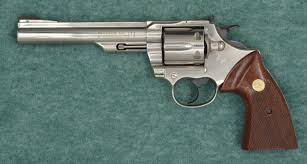
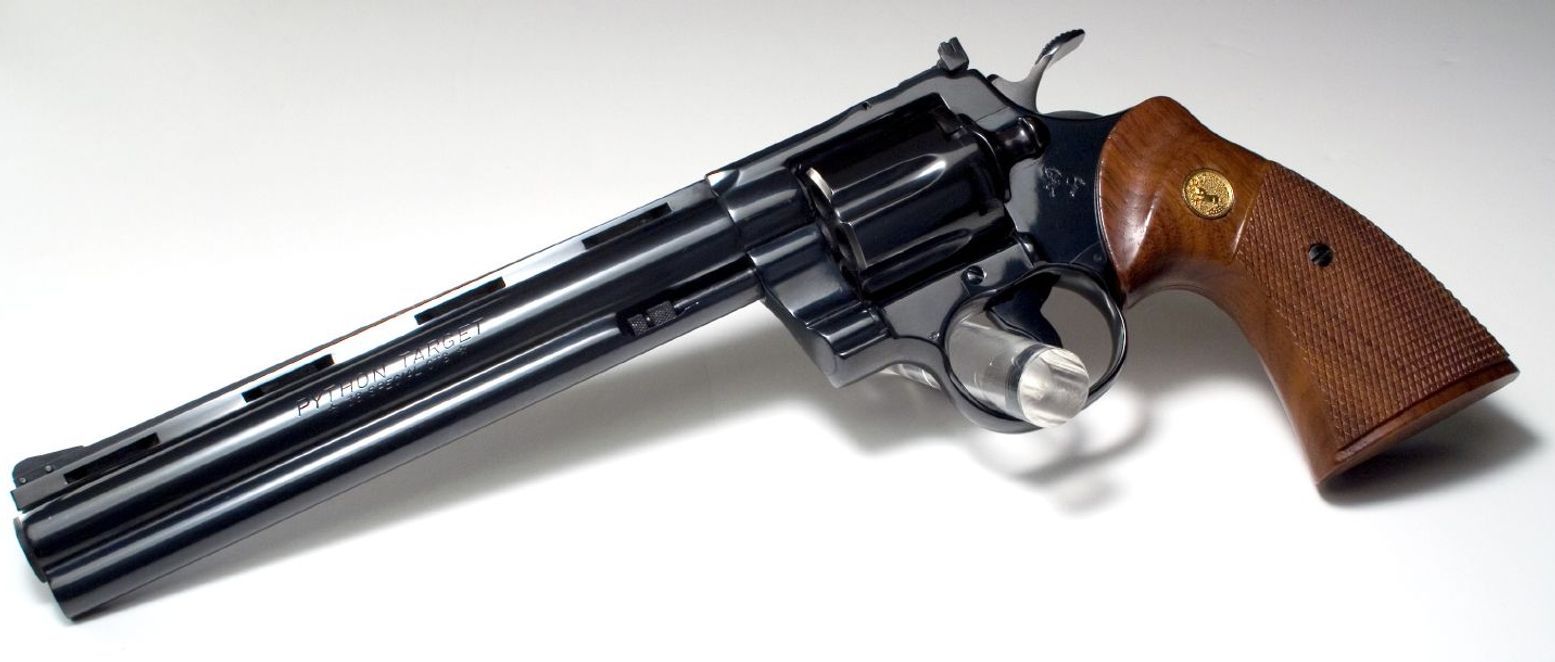
>COLT PYTHON 22 LONG RIFLE CALIBER: Can you imagine a more luxurious rimfire revolver? Throughout the years, I have built a handful of these. It came at no small price. Just think, if they made one of these today, it should sell for $1500 - $1600. I would like it to have match chambers and hold no more than 6 shots. This should not be an exercise in seeing how many holes we can drill into a Python cylinder. It should simply be a masterpiece with world-class accuracy.
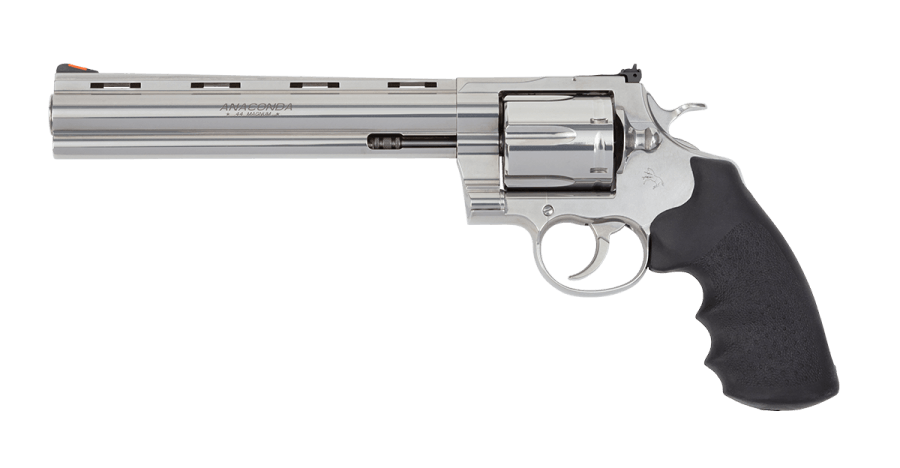
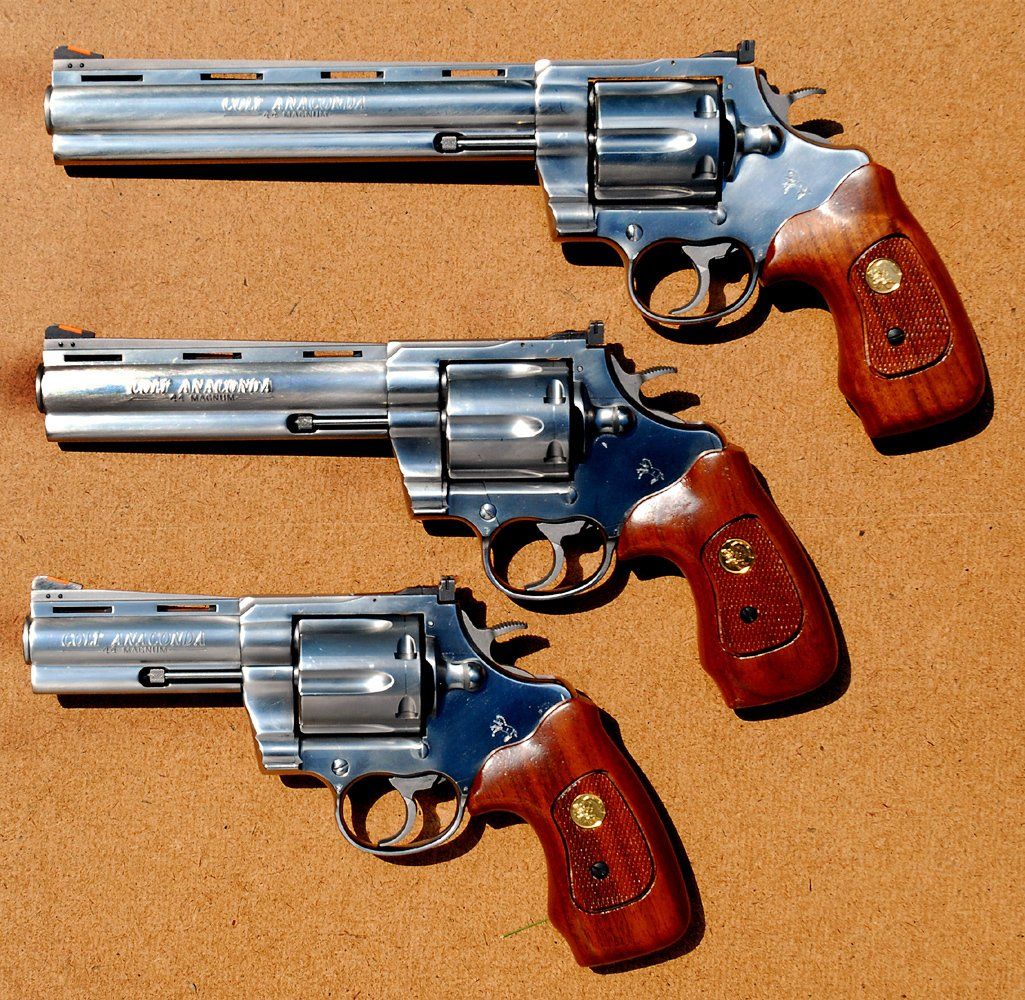
>COLT ANACONDA 45 ACP REVOLVER: I do have a few specifics about this gun that are important. I'd like it to have a shortened cylinder, no longer than what is needed for the 45 ACP cartridge. Extend the barrel shank into the cylinder window until it meets the cylinder. This will improve accuracy over leaving the long cylinder unaltered. It will also result in a lighter cylinder that's easier to rotate during rapid-fire double-action shooting at things like....bowling pins! A classic Colt with a modern hot-rodded flare!
>COLT ANACONDA 445 SUPERMAG: This is conceptually a very sound concept for the handgun hunters among us. Several years ago Dan Wesson introduced a Metallic Silhouette revolver chambered in a new caliber, 445 SuperMag. Compared to a 44 Magnum, which has an overall case length of 1.275", the 445 SuperMag has an overall case length of 1.6", which obviously allows for greater powder capacity. Ballistically, the 44 Magnum will fire a 240-grain bullet at around 1450 fps from an 8" barrel. A 445 SuperMag will fire a 240-grain bullet at around 1700 fps. These velocities will vary from source to source, but the difference becomes even larger with heavier bullets due to the 445 case length. This velocity gain is also achieved at very similar pressure levels. We're talking about chamber pressure levels of about 41,000 psi, where the 454 Casull (for example) gets up to 65,000 psi. While the 454 Casull has more sheer power than the 445 SuperMag, the SuperMag has a flatter trajectory at distance, which makes it a Hunter's Best Friend. There are numerous bullet styles available with numerous construction techniques from the 44 Magnum that are fully compatible with the 445 SuperMag, so handloaders would have a large variety of options. It would be a very sensible caliber choice for handgun hunting because it doesn't displace your shoulder blades upon firing like the mega-magnums out there such as 454 Casull, 460 S&W, 480 Ruger, and 500 S&W. Due to much lower pressures than any of the mega-magnums, the 445 SuperMag is much easier on barrels too....and revolver frames.....and revolver lockwork....and cylinder assemblies. It's a logical "middle of the road" for the handgun hunter, and I would love to see it happen!
>QUALITY REVOLVER/S FOR THE 22 TCM CARTRIDGE: If you don't know about this cartridge, you're not alone. This cartridge, treated like the red-headed stepchild of the semi-auto pistol world, is actually quite amazing. This is the 22 Tuason Craig Micromagnum. It was devised by Rock Island/Armscor CEO Martin Tuason, and Rock Island Custom Gunsmith Fred Craig. It uses the .223 as a parent case. Its necked-down length is about the same as a 38 Super. The projectile is a lead-tipped hollow point with a half copper jacket that weighs 40 grains. The velocity? Out of a Rock Island/Armscor 1911 pistol with a 5" barrel, over 2,000 fps. That is what they claim, and their claim is factual. That SMOKES the FN 5.7 x 28. Semi-auto pistols firing this cartridge don't need gas operation or other elaborate schemes. Things work out just fine with JMB's Recoil Operation. I suspect due to its origins, nobody will load for this except Armscor, and nobody will make a gun for it except Armscor. That's really too bad, because I made 1 single-action revolver for this round (I will never make one again) that has an 8" barrel, and I'm getting about 2200 fps. Shooting this thing at a distance is an absolute blast! Talk about flat trajectory! I did build, using a Rock Island conversion kit and some tuning, a "Target-Level" 1911 for this cartridge, and between this and my revolver, I have learned this cartridge is capable of excellent accuracy as well. As a defensive cartridge? I don't imagine that being struck with a 40-grain 22 caliber hollow point traveling at 2000 fps would do anybody any good. I should note, if you shoot this around dusk, you'll notice the muzzle blast. The sheer amount of fire coming out of the muzzle is almost hilarious. If the bullet missed, its flame-throwing nature is sure to do something. This cartridge has a great deal of potential. I would love to see a quality revolver chambered for it, some higher quality semi-auto pistols chambered for it, and see cartridge companies load for it. I should mention, it's virtually recoil-free.
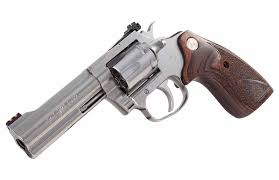
>COLT KING COBRA (all variants) 9MM CALIBER: This one is almost a little obvious, but hey. The 9 x 19 would require full-moon clips to operate in this setting. That's fine, as that's how the other companies do it. You can have one loaded clip in the gun and have another couple of loaded clips in your pocket. The performance of this cartridge is plenty, especially when using +P ammunition with properly constructed bullets. Ammo such as this doesn't always feed the best through every pistol, but a revolver doesn't care! I have a Smith & Wesson Performance Center with a 7-shot cylinder and a 2.5" barrel. It's an "L" frame. Sometimes I run it with an optic and shoot some pretty small stuff at 25 yards using mediocre 115 gr ammunition. It's fun! It would also be highly effective in a defensive revolver, and I'd love to see Colt offer this as well. While I'm at it, I would love to see an alloy-framed Cobra. That gun would be very nice if it lost a bit of weight.
9/20/26: HANDGUNS ON TODAY'S MARKET THAT QUALIFY AS BARGAINS; MY TAKE: There are a number of reviewers out there claiming that we've entered a "New Golden Age of Firearms". I must admit, to an extent, they are correct. But why? What led up to it? Did things get worse before they got better? Are things better? While this company concentrates on Colt Double-Action revolvers, don't think for a minute that other brands and categories aren't examined, customized, deeply evaluated, and scrutinized from the inside out and from the outside in during our off time. I do actually get free time, and when I do, my hobby is (drum roll please): FIREARMS.
FIRST LET'S EXAMINE WHAT HAS LED TO THIS "NEW GOLDEN AGE". The quick answer is manufacturing technology and the internet. Manufacturers are learning what people want. The manufacturer making the product quickly learns the consumer verdict on the product, although some verdicts that run on the negative side often are overly dramatized. The BIG factor is MODERN DAY DESIGN, ENGINEERING, and MANUFACTURING TECHNIQUES. There have never been as many firearms on the market (that actually function reliably) as there are right now. Take polymer pistols, for example. At one time, Glock was the only game in town. Despite their long and spongy triggers, awkward grip angle, and pain-inducing trigger guard, it came down to reliability. If a person or agency wanted reliability in a polymer, it was Glock, period. Things have evolved. Reliable 9mm polymer pistols almost grow on trees, and what separates them are things like grip angle, trigger quality, accuracy, controllability, grip texture, optic mount capabilities, and last but not least, personal taste. That is where the market is at in virtually every category. Poor to fair tolerances are no longer tolerated in the least. Even good tolerances might not make the grade. Very good is the bare minimum. Yes, we are at that point. Imagine what will happen when machine/program dedicated AI starts dialing things in even closer. The best machines already adjust for cutting bit wear automatically.
So, without further delay, in no particular order, here are some of the highest-value handguns on the market. These all fit into a niche, but some of these simply offer incredible performance for the money spent, and some offer even more with some proper TLC. If there's something I left off, it may be due to a specific reason, it may be due to a lack of experience with it, or it could be that my thinker didn't think of it. This WILL be a growing and expanding list. Over time, there will be guns added as I find time to do that and as discoveries are made. Here we go!! IN NO PARTICULAR ORDER:
CANIK RIVAL 9MM: Yup, a Turkish polymer pistol. Street price is around $650, and for that amount of money you get a comfortable gun with a 5" barrel, 4 optic plates, 1 plate with adjustable iron sights, 3 backstraps, 3 magazines, a nice case, a usable holster, and one of the very best striker-fired triggers this side of $1500. People have won championships with these. They offer decent build quality and reliability. It's an overall competition package that performs FAR beyond its price in every area. There is ALSO the CANIK RIVAL S, which stands for "steel". Rather than a polymer frame, this pistol has a steel frame, and includes all of the accessories of the RIVAL. At fifteen hundred, it would be a killer buy, but it doesn't cost that. They're actually around $899. Keep in mind that CANIK is an Aerospace facility that's designing and building firearms too. With competing "heavy frame" striker-fired pistols easily costing twice as much, the CANIK, which is just as accurate, has fabulous ergonomics, comes with several optic plates and adjustable irons, and frankly the best striker-fired trigger I've encountered at any price (outside of spending some money on Glock-compatible components and skillfully modding them), this pistol is a screaming bargain that's a blast to shoot.
KIMBER 2K11: Considering the outrageous 2011 pricing out there, this gun seriously overhauls the expectations of what's possible. With Staccato 2011 pistols being the "measuring stick", and most brands costing more than Staccato (which has many variants in the $3000 - $4300 price range), Kimber has successfully pulled out a product that frankly rivals Staccato "anything", for a lot less money. The triggers fit better, the pull is at least as good, they shoot FLAT, the pistol is highly ergonomic, the accuracy and reliability are phenomenal, and they come with just an optic mounting plate, comped or not comped, or with adjustable iron sights; they are highly attractive with performance to match. Prices typically run $1900 - $2500. Either the 2011 manufacturers have been flogging us, or Kimber has unlocked the combination to "Magical Manufacturing". Either way, this gun will get the job done.
ROSSI RM66/64 DOUBLE-ACTION 357 MAG-38 SPEC REVOLVER: I didn't see this one coming, but in a way I did. Years ago, like, 1980s years ago, Rossi had what was probably the only value-segment imported double-action revolver that got the basics right. Their action design has remained the same for years, a virtual copy of a Smith & Wesson, except the Rossi uses a coil mainspring. A friend brought a brand new one by a few weeks ago just to get an opinion. It had a crisp trigger, the action was reasonably smooth, the throats were even, it was stainless with a 6" barrel and fully adjustable sights. All for around $550. After he left, I found myself ordering one because I thought his might have been a unicorn. Nope. Mine met the criteria. Rossi may be owned by Taurus, but in this category, Rossi has the better revolver. It won't make you throw your Smith, Colt, or Ruger in the crick, but for the price I don't know how they did it. They are good shooters too!
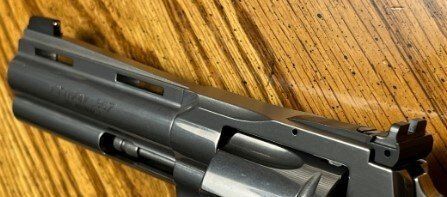
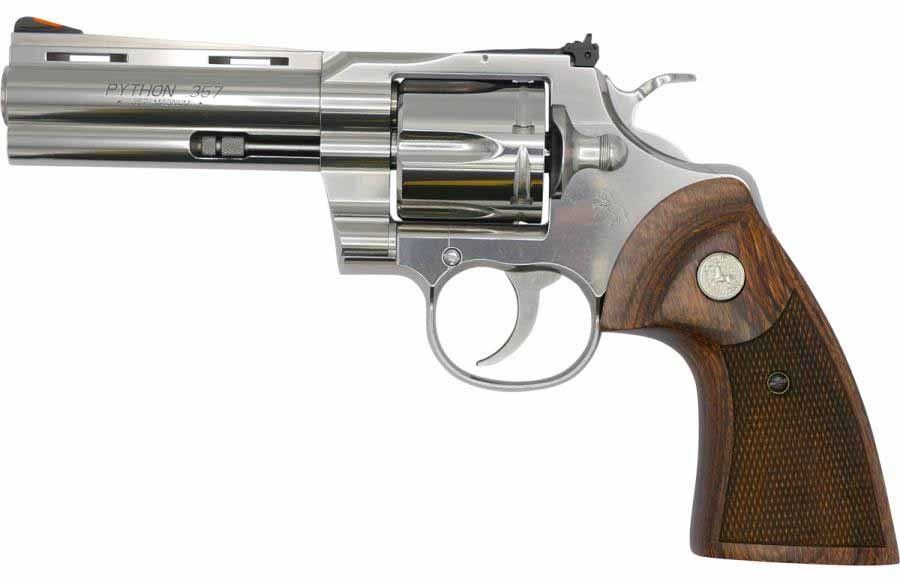
COLT PYTHON-ANACONDA (and variants) 357 MAG AND 44 MAG REVOLVERS: OK. Some of you are wondering what revolvers of this price category are doing on a "best value" list. I'll tell you. For the price you pay (which can be anywhere from $1300 - $1700 depending on finish), you are buying the only American-made double-action revolver that can challenge the tolerances presented by companies like Manurhin, Korth, or Spohr. Ruger can't do it. Smith & Wesson can't do it. The Dan Wessons can't. Only the New Series Colt Python/Anaconda revolvers and their variants. They are the most accurate out-of-the-box American-made double-action revolver you can buy, even surpassing the accuracy of Colt's previous efforts. The tolerances are brutal on these. Because every domestically manufactured double-action revolver currently made needs a bit of TLC for the serious shooter, for around $250 we can do a Component Part Tune© that will slick it up and give you superb trigger pulls. If you're more of a World Class shooter or collector, we have the Signature Series Gen III© that's a shade over $1K, and your Colts will make the high-dollar Euro Super Revolvers run for cover! You'll be basking in the glow of the rifle-like accuracy and high-end rifle-like trigger quality from your Colt revolver. Add together around $1500 for the Colt, and around $1000 for the tune, and that's far less money than the $5K and up for a Manurhin or Korth, and you'll have the better gun. THAT is what makes them a bargain with a capital "B"!!
AMERICAN PRECISION FIREARMS STRIKE ONE SPEED: This is a polymer frame striker-fired 9mm pistol featuring an extremely unusual design. It has an extremely low bore axis (due to its locking system, which they call "Speed Lock," a variation of the Bergman system), a fully adjustable rear sight, and a trigger that starts out at about 3.5 lbs and, after break-in, it's around 3 lbs. Not a crisp break, but rather a smooth "rolling" break. This pistol was designed in Italy. It's manufactured in Italy by Arsenal Firearms, the people that bring you the double-barrel 1911 pistol. The ORIGINAL purpose of the pistol? Russian Special Forces! Russia did use it for a period of time, until they found out the designer was making them commercially as well. Then, they dropped it like a hot potato. At one time (early 20-teens), it was manufactured by Tanfoglio. These were not the best examples of what this design can do. Current production (the last 4 or so years) has been very good. This is a very flat-shooting pistol that also demonstrates incredible accuracy compared to its competition. At around $1100, it can certainly be considered a high-end polymer gun, but I know guys who very successfully use these for bullseye shooting. My personal Strike-One Speed has a ton of rounds through it, and it's just fine. In fact, just this morning, I fired a couple of unsupported 50 ft 5-shot groups of under an inch! From a target shooting perspective, I've compared this to other polymers in its price class, and this is Top Dog. For what it does and can do, it's actually a very good buy!
TISAS 1911-A1 PISTOL: This is probably the most accurately represented 1911-A1 WWII-era pistol on the market. It doesn't hurt any that, as a general rule, they work great out of the box; the steel is really good, the internal parts are machined steel (!), and finding them for under $400 is a simple task. These pistols are extremely solid. I have used several of them for custom builds. Even.... Nighthawk has used these for custom builds! Tisas has been around for approximately 30 years, and their factory and manufacturing technology is highly sophisticated. All of the steel used is heat-treated 4140, and the slide, barrel, and frame are forged. For G.I.-level 1911 pistols, I don't know of a better value anywhere.
SPRINGFIELD ARMORY PRODIGY 2011-STYLE PISTOL: The Springfield meets all of the criteria to be a 2011-style 9mm pistol. When it first rolled out, it had a few bugs to work out, but they fixed 'em. Some people on the forums love to flog these pistols mercilessly, but here are the facts: Both Ed Brown and Nighthawk offer hot-rodded versions of this pistol, and that's NOT because they suck. The Prodigy is now reliable (if yours isn't, send it back), and these pistols offer excellent inherent accuracy. These are among the select few pistols out there that can group under an inch at 25 yards. The recoil impulse is very soft. The steel used (and the polymer for the grip) are of very good quality. Some people do replace the MIM parts used in the ignition mechanism (hammer, disconnector, sear) with machined parts by Wilson, EGW, Nowlin... but you're better off leaving it stock until you find someone qualified to do such work. I actually own one of these that I use as one of my precision-shooting pistols, and it qualifies as such! I have found 2011-style pistols to be extremely ergonomic for precision shooting, and the Prodigy is no exception. Some YouTubers might criticize the grip, but they're from the "Go Fast" crowd. For precision shooting, the grip is just fine. These can typically fire 1" groups with some sort of ammo right out of the box. With some massaging, they'll do that with a wider assortment of ammunition, with groups flirting in the .6 - .7" region at 25 yards. The street price varies from $1300 - $1600 depending on ported, not ported, etc. Yes, there are other pistols in that price range, but Springfield is an established and well-known maker, and their gun is highly competitive. What really makes it such a standout is the accuracy potential, which can compete with 2011-style pistols several times its price.
SMITH & WESSON VICTORY 22LR PISTOL: These pistols start at $469 and go up from there. There seems to be a trio of choices within this range. There's the Ruger MKIV and the Browning Buckmark. They are all accurate, they're all reliable, they're all VERY close in price. What the Victory brings to the table is the best trigger pull (which also has an adjustable overtravel screw) and in our comparative testing (done 2 - 3 years ago), the tendency to shoot the tightest groups, not that the other 2 were in any way inaccurate. There are many accessories available for the Victory. It's simple to field strip. It's easy to work on. It offers an easy and clear DIY pathway to being a High-End target pistol. The Browning and Ruger offer such pathways as well, but getting there isn't as easy as it is with the Victory. I know a guy who uses one that's bone-stock for bullseye, and he rocks the house, no doubt due to its better-than-average trigger and accuracy. You get more than you're paying for with this one.
DAN WESSON DWX FULL SIZE 9MM: $2500 likely seems like a great deal of money, and it is, but for that price you get an exceptionally well-made pistol that's highly unique. Meant to be a 1911/CZ75 hybrid type of pistol, it's highly ergonomic, built like a precision tank, and with a little of the right custom work, there is performance lurking within this pistol that can overhaul perceptions about the value of a dollar, even when the final price is considered. From an accuracy and ergonomic perspective, one of these with proper performance tuning is about as good as it gets.
PIETTA 1873 SAA CLONE REVOLVER: These do have a somewhat wide price range starting at around $500 and topping out at about $1000, with the higher-priced models having engraving, etc., but they are fantastic bargains. For one thing, unlike Uberti-manufactured clones, the Pietta is dimensionally accurate, even using the same thread pitch for the screws and barrel. These are essentially a direct copy of a 2nd Generation Colt SAA, with 1 exception. The hand spring, rather than being a leaf spring peened to the hand (which was prone to breakage during Cowboy Action Events by over-zealous shooters), has a coil spring with a plunger going through the frame, applying force to the hand. Otherwise, even this modified part will fit in a Generation 2 SAA. The steel quality of these revolvers is excellent, surpassing Uberti in several areas, particularly in screw quality. A genuine Colt has a replaceable firing pin bushing and a replaceable hammer cam, both parts that are subjected to a fair amount of wear. Oddly, Uberti, and even America's Standard Manufacturing, do NOT have separate bushings or cams. Pietta does, and they'll interchange with the Colt. Other than the finish, due to the elaborate procedures used by Standard, I prefer a Pietta SAA clone over a Standard Manufacturing SAA clone (which has many parts NOT interchangeable with the original Colt). If you're looking for an authentically styled single-action revolver, the Italian-made Pietta is a stone-cold bargain!
BERETTA APX 9MM PISTOL: This pistol is more of a defensive/range shooting option. They are (in my opinion) a bit heavy for carry, and as a competition pistol, its trigger is a bit heavy and grainy. Where the APX excels (whether it be the original APX Full-Size or Compact or the newer A1 Full -Size or Compact) is in the area of durability and reliability. Once broken in, an APX can feed and chamber empty 9mm cases! The polymer used is VERY tough; the fire control module (which is removable) has full-length rails, and the steel everywhere is extremely tough. We were hired years ago to perform durability testing on this pistol for law-enforcement use. I don't know if I've ever seen anything more durable. We even ran over it several times! Beretta designed this for the U.S. Military trials when they chose the SIG P320. While the APX is more of a "tool", it's the superior firearm by a great deal (a sidearm IS a tool). Extremely reliable, insanely durable, with a reasonably low bore axis and a trigger that's not great, but still better than a stock Glock trigger, it's a $400 retail (sometimes with a rebate on top of that) miracle of a fighting pistol. I should add, PART of the reason that the trigger isn't wonderful is that it isn't fully cocked. It's only partially cocked upon closing, with the trigger press finishing the remainder of the cocking stroke. That's why the trigger is 6 lbs and "spongy", but that feature only adds to this Italian-made Beretta's safety. I should mention, the grip and the texture combine to create a highly ergonomic and functional package. It comes with 3 backstrap/side panels. One note: this pistol doesn't do well with the plentiful underpowered 9mm cartridges out there. This gun was designed and built for NATO combat use. It's designed for standard-full pressure 9mm ammunition, and it handles hot +P using a variety of bullet types with ease. As a defensive, law enforcement, or range pistol, you cannot lose.
RUGER SUPER WRANGLER: This 22 LR/22 Mag adjustable-sighted single-action revolver is a price-point miracle. It's very similar to Ruger's Single-Six, except the Wrangler uses an aluminum frame, Cerakote finish, and purely MIM parts, whereas the Single-Six has a steel frame; it's actually blue or stainless, and the internal parts are CNC -machined investment cast. This does not keep the Wrangler from being a solid revolver for the beginner or as a fun toy at the range. They are accurate enough, and they actually hold up. They are light years beyond a Heritage Arms. I see these around for roughly $270. Long Rifle and Magnum cylinders, properly timed, durable enough for lots and lots of range use, adjustable sights, accurate enough for lots of fun plinking, and it's a Ruger. You cannot go wrong.
DAN WESSON 1911 PISTOLS: If you're longing for a Wilson 1911 pistol but the price makes it unobtanium, don't despair; there is DAN WESSON, and they come so close it might not even matter. Dan Wesson 1911 pistols are more or less meant to be "pull it from the box and use it" rather than projects. They prove that my father's statement concerning guns, "That last 5% costs the most," was entirely true. Considering the overall quality of these pistols, I honestly don't know how they do it for that price.
SPRINGFIELD ARMORY 1911 PISTOLS: I'm talking about the new model introductions in 2021, 2022, 2023. Due to a sizeable investment in state-of-the-art equipment, this era (current) offers performance that almost doesn't make sense. The triggers out of the box aren't terrible, and the accuracy potential of these pistols (it seems like the higher you go, the better it gets) is incredible, even rivaling 1911 pistols 4X the price. The steel quality of the slide, frame, and barrel is fantastic. The barrels are good quality. If you can't make the jump to Dan Wesson, and you want something more upscale than TISAS, this is a good place to go.
So, at least for now, this is the end of my list. There are likely others, but currently nothing else has made THAT big of an impression. The handguns I've listed are standouts at their price points. I've had pretty extensive experiences with all of them. I won't apologize for the number of 9mm pistols on here. They are part of this Golden Age as well. Some of us remember a time when the concept of buying a semi-automatic centerfire pistol that would feed reliably out of the box was extremely rare.
9/7/2026: THE MOST CURRENT NEWS - SIGNATURE SERIES ULTIMATE COLT TUNE© GEN III - THE 9 X 19mm NEEDS SOME MORE LOVE....and A DREAM:
THE MOST CURRENT NEWS: First, we are closed for Labor Day, as in CLOSED. I'm going to have an employee revolt on my hands if it doesn't lighten up a touch. I did acquire another employee. So, we have an "as needed" Machinist, Matt; a part-time to full-time Master Pistolsmith, Lawrence; Tammy, my wife, who runs interference and attempts to coordinate The Wrecking Crew; and now Larry (we cannot have 2 Larrys or 2 Lawrences, so it's Larry). This guy, while not attending any gunsmithing schools (which, in my opinion, works in his favor), is simply handy. He knows a fair amount about guns; he is careful to a fault, and he has sound judgment regarding what he cannot do. In this game, knowing what you can't do is more important than knowing what you can. Both are part of the larger scope of essential knowledge. It's remarkable how much it helps just to have someone here to do cleanup, disassembly, and Ransom Machine Rest testing (which he knows VERY well because he's a handgun accuracy fanatic and owns his own rest).
OH; and we were hacked.....again. This time there were multiple ticket purchases made at Sam's Club. I am feeling targeted. If anyone should find out who it is, please have them professionally packaged and shipped here, freight collect. This is just over the top. And of course, we are still busy. Not only from normal orders, but it takes time to catch up from 10 months of medical absence. I thank you all for your patience!
THE SIGNATURE SERIES ULTIMATE COLT REVOLVER TUNE© GEN III: Oh yes. It's quite remarkable. I have implemented a slight name change, as it is a COLT REVOLVER ONLY tune. In a sense, I'm not entirely sure whether to call this a "Tune" or a "Modification" or a "Precision Remanufacture", but I have thrown everything but the kitchen sink at the New Series Python-Grizzly and Anaconda-Kodiak. Everything I know, and everything I've learned from working with these guns and prototyping with them, is what goes into them. It's substantial. For years, we've had High-End Korth and Manurhin shooters switch to our Signature Tuned Colts. The Signature III is likely my final word on the subject. I simply don't know what else to do. Everything has been addressed. The reception to this new iteration has been overwhelmingly positive, with even a sense of excitement. They represent an entirely new level of slick, crisp, light, smooth, and accurate; done right here in the USA. While not inexpensive, the final expense is something of a bargain when you consider that lesser-performing European High-End revolvers cost 2 - 3 times the price of a Signature Tuned Colt. $1050 Stainless $1150 Blued The best there is.
THE 9 X 19mm NEEDS SOME MORE LOVE: While I realize that revolvers do exist chambered in this caliber, I'm surprised that more are not. When I was growing up and learning about such matters, I, and many others, viewed the (now) 9mm NATO as a cartridge with dismal power and poor accuracy. In a sense, we were all correct in that assessment. The bullet designs were horrible, quality control at ammo factories was poor, and the guns made for it were...blah. Other than the SIG P210 (back in 1980 it was Swiss-made and retailed for around $1400, which would be about $7000 today), accurate pistols chambered in the 9mm were like unicorns. When the entire "Wonder-Nine" thing erupted, most shooters didn't even want to hear about it.
ENTER THE MODERN ERA: A great deal has been learned and applied regarding bullet structure (related to accuracy and defensive use), quality control at ammo plants is better, and there are a great many pistols on the market that shoot 9mm cartridges with surprising levels of accuracy. An off-the-shelf Glock will shoot circles around most off-the-shelf 1970s and 80s era Colt 1911 pistols. Some of my most accurate centerfire pistols are 9mm. Sig P210 Target (American), SIG P226 XFive (American), a custom Glock-format "clone" pistol that I built specifically for target use. I copied the 17L. I threw every accuracy trick at it I could. It has a 2.5 lbs trigger, and it can shoot 2" groups at 50 yards. I have built a few 9mm 1911 match-grade pistols that can shoot sub-1" groups at 25 yards all day. There are even inexpensive 9mm pistols that can offer an amazing amount of fun for not much money. CANIK is one that comes to mind, a company that offers striker-fired triggers that don't feel like it. I own a Shadow Systems that is a Glock-format gun, but on the High-End side of things. It's a fantastic gun.
JUST STOP AND THINK.... The 9mm NATO or 9 x 19, whatever you wish to call it, is the least expensive factory ammunition you can buy, period. It's because it's the NATO round. It's so plentiful it practically flies out of PEZ dispensers. This caliber, when chambered in a revolver, offers low recoil, good accuracy, and there are many different loadings to choose from. I own a Smith & Wesson 9mm Performance Center revolver with a 2.5" barrel with a mounted Trijicon RMR. At 25 yards, I pound the crap out of a 3" gong. It's a blast!
I know there are 9mm "haters" out there, and much of it has to do with gun publications cramming it down our throats, but there are two sides to every cartridge. I would love to see Colt introduce a few revolvers in 9mm. Maybe a King Cobra, the King Cobra Target... Those would be some very good options.
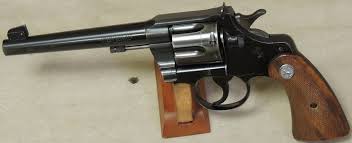
ABOUT THAT DREAM: The New Series King Cobra 22 by Colt is a fine revolver, but I want more. I want a rimfire revolver that is a "Statement Piece" regarding what is possible. Have you ever fired a Colt Officers Model (discontinued in 1969) chambered in 22 LR?. It WILL alter your perspective on things. The accuracy capabilities of these fine revolvers are absolutely incredible. Find the right ammo? It will shoot sub-1/2" groups at 25 yards. The revolver was introduced in 38 Special in 1908, using the same frame as the Army Special (this frame went on to become the Official Police, the original Trooper, the 3 5 7, and the Python). Yes, it's a 22 LR revolver with a Python frame and action, or more accurately, the Python had an Officer's Model frame and action. ENTERING THE PRESENT DAY, a New Series Colt Python chambered in 22 LR would be incredible. With the tolerances Colt has now, wow. Colt catalogued such a critter in 1981, but it never came to be. Despite a strong recession, consumer excitement was substantial, to put it mildly. They COULD have called this DIAMONDBACK, except some company came along and took the name while Colt wasn't using it. It was all legal. A TRUE 22 LR companion to the Python would be a fabulous firearm. As near as I can figure, it really wouldn't be THAT big of a thing. New barrels, a new cylinder, and a slight change to the ignition system.
Wouldn't that be neat?
I hope all of you had a nice Labor Day Weekend. Have an enjoyable and SAFE week! -Mike
8/13/2026: TECHNOLOGY CHALLENGES :
TECHNOLOGY CHALLENGES: A few weeks ago, someone on the Colt forum was explaining how "bad" - "dated" our website is. "To stay competitive in the market with the current competition, their website needs to look like this company, or that company". While I cannot disagree that our website will not win a beauty contest, it IS hands-down the most detail-oriented and informative anywhere. My concerns are more about that than pretty pictures. Throughout the years, I have been told countless times, "I learned so much going on your site!" or something to that effect. That's exactly what I want to hear.
Being a business on the small side (me, wife, 1 pistolsmith, 1 machinist), technology can easily become more of an "Efficiency Hindrance" than an "Efficiency Helper". Trust me on that one. Like websites. We HAVE to have them. We've had 3 websites over twenty-some odd years. A while back, without my permission, my Website Builder (Duda) decided to introduce me to AI. It slid in and took the information on my site and made it far more informative regarding what we do here. I had a website full of snake pictures. Yes, snakes, the reptilian creatures. Then it went on to explain (for each snake) where they can be found, whether or not they were dangerous, etc. I was like, "Hey, thanks for the help!" There was a way to reverse it, which I did promptly.
Then, there is yet another side to technology. The hacks we experienced (it's pushing 2 months now) are still haunting us with "side effects". I'm still fighting with PayPal about $9800 for a "roofing invoice" that was sent to me and was paid! Not by me though. Right now, my old hard drive is going through a "forensic analysis" to prove that I was not on the computer or my tablet or my cell phone when this happened. When I bought the new computer, it had the latest versions of Microsoft Office on it. We have SO many documents that we routinely use that were made using Word or Excel, but older versions. The new versions don't play well with the older versions. I have over 4 years of pending sales orders that I cannot retrieve because of the clash between old and new. Then I load my laptop with older versions, and the sales orders still will not open because they have "changed" by transferring them to Windows 11 with new Office software. My local IT guy (former FBI IT fella) has thoroughly examined things, and the short version is: "You're screwed". This hack IS the gift that just keeps on giving.
We must have email (which I don't think is even working right yet), and we must have a website. I must have the ability to print certain documents. Outside of that? We are going back to paper orders. Having the ability to immediately look up an order is great, but now that's been tossed out the window. I can't look them up at all! Not at all my version of a good time.
If you contact us about an order, please have your order number handy. We pretty much can't look it up at all without it. We have sunk an enormous amount of time into this situation, and it's been unbelievably expensive. I am not going to chase my tail any further regarding this matter.
Everyone, have a fantastic AND safe week! -Mike
6/29/2026: WE ARE CLOSED THE WEEK OF 6/28: In celebration of our country's 250th year, we will be dialing it back the week of 6/28/2026. We will reopen on Monday, 7/6/26. Because we are never "truly closed", we will be here continuing to ship out products, working towards the completion of data transfer onto the new system, working on products, and conducting some much-needed shop maintenance. We will not be answering the phone or emails this week. It is crucial that we complete what we need to complete. This is our chance to do it.
I hope everyone has a safe and enjoyable 4th of July. -Mike
6/17/2026: MODERN TECHNOLOGY HAS US IN A STATE OF LIMBO: After a computer hack that involved a total of $14,471.51 of charges and withdrawals against the Heffron Precision© credit cards and bank account a few days ago (we didn't have to pay anything), I purchased a brand new computer, because there were no promises that the Malware could be removed. Everything was successfully moved to the new system (company-related documents, etc...). Guess what? We've been attacked again! This time, it was "just" the company checking account, to the tune of $9800. This time, they left more of a forensic trail, making it possible to find the source, which is surprisingly not foreign. This appears to be the work of someone within the US. This time, they used the company PayPal account to gain access to the $$$.
The bad news is the Malware is sneaking in through email, at least THIS time that was the origin. I cannot open my computer. It has to remain shut down until a new SSD is installed with all of the software, and then file transfers must take place again. I must set up new Microsoft and Google accounts. Like any business now, we are so computer-dependent that we can't even go to the bathroom without the computer being involved! (I, of course, say that in jest, but I'm confident that it's coming in the future.)
From a computer communications standpoint, we are shut down. From a shipping standpoint, we are shut down. Ordering parts? Shut down. Right now, I am typing this with my cell phone. What I wouldn't give for some "private time" with the S.O.B. who's done this. Lost communications, lost days, money out of pocket, and all because someone has decided that they will steal for a living. To think that this all started because of a single email that I opened. Then, the system was contaminated all over again! The frustrating part is that the emails appear totally innocent because they arrived under a customer's name. This is some very clever hacking. That customer did NOT send them,
Email is down. I don't dare do anything with it. Every password for every vendor has to be changed. To my surprise, that's 144 passwords. The big switchover is starting today, and I don't know when it will be finished. I'm estimating it will take the remainder of the week and into the weekend.
For the next couple of days, I'm going to be in the shop in a very big way. When I'm fielding the office end of things, there are many things that do not get completed in the way of shop work. This has already taken FAR too much of my time. I will have to trust that those working on this security issue and the data transfers do it right.
Thank you for your understanding. IF you happen to stumble into someone who says, "Oh, ya' dude. I hacked Heffron Precision!", could you please box them up and ship them here? It would be greatly appreciated! (just kidding........sort of)
I do hope that everyone has a great day. -Mike
6/9/2026: WE ARE GOING TO BE CLOSED (MOSTLY) FOR THE NEXT 2 OR 3 DAYS, WHEN IT RAINS, IT POURS!!: We live in a world with all kinds of people. I have found that most people (at least within my Conservative circles) are good. Some of these people are exceedingly intelligent. They find healthy outlets, and some have even used these talents for occupational purposes.
Then there's the "Other Side". Highly intelligent people who use their "talents" to destroy. Take, for instance, yesterday, when some individual's Malware invention literally "carpet bombed" my business computer. I was tipped off to it by receiving texts from my bank and credit card companies, checking on numerous attempted transactions totalling $14,471.51 that I had NOTHING to do with! The good news, none of them went through. The bad news? I have been advised to either have a new hard drive installed with fresh programming OR simply buy a new computer. I use a desktop for business, so that's what I'll be getting. I've opted for a new computer.
While the price of getting a new computer isn't the end of the world, it's not chump-change either. The biggest irritant is the time it will take for someone to transfer all of these files, etc... to the new computer. Multiple apps that will need reloading. This is when I wish that I'd used the "Cloud", but I never quite trusted it. So much for my "Hillbilly Common Sense". As a business owner, everything that happens immediately translates to "expense" in dollars between my ears. Take something like this. It's not like someone hacked the computer system of Walmart, but figuring overhead combined with wages per person, the total hours likely involved, and the computer cost, this will be an estimated $2000-$2500 expenditure all so someone could attempt to access credit card numbers. That's nowhere close to shutting the lights down, but it is significant when that loss is essentially directed at repairing vandalism executed upon your business. This is no different than someone causing $2500 worth of damage to the main door and some windows, trying to break into a business on Main Street.
I will be heavily involved in guns and computer stuff for the next few days. I'll take calls when I can, emails will not be answered for right now, and Tammy will be up to her neck within the "Computer Domain" while cursing me under her breath.
Have a great week. -Mike
6/1/2026: PHONE INFORMATION: For quite a while now, our "answering service" has been really acting up. Our system was, I thought, rather cool. It worked in tandem with the computer. People's messages wouldn't only be stored verbally, but I was able to save and print out what they said. It was really handy......when it worked. This system has had all of the reliability of a hot beverage machine (where you'll get a cup, hot water, no coffee OR coffee, hot water, no cup OR cup, coffee, no water, etc...). I'll get a verbal of the message, but nothing in writing, or I'll get a notice that I have a message, but nothing is there in writing or verbally. Then, there's the issue where it doesn't play MY message when someone calls; instead, it asks for a PIN. Over the weekend, I finally had enough. "The Man" comes here, fixes it, it works for maybe half a day, then it craps out again. Yesterday I went to Amazon and ordered a normal cordless phone with two handsets and a built-in answering machine.
So, the moral of the story is, hopefully, this will result in more normal message behavior when you call.
Everyone have a great week. -Mike
5/27/2026: THE EMAIL MALADIES: I thought it was all figured out. How wrong I was. Several weeks ago, I lost every email prior to April 2026. My designated Computer Guru said it was likely some sort of Malware that came from who knows where. Shortly after that was posted on here, I discovered that while the April emails would show up in the "Inbox", when they were opened, they were devoid of any contents. Nice. My Computer Guru has done all that he can. We need to consider April's emails to be gone as well. So, the only emails I have are for May 1st, 2026, and on.
So, if you emailed us requesting information or to place a component parts order prior to May 1, 2026, we cannot access your email. If you still need help or need to place an order, please email us again with your request.
Thank you in advance for your understanding regarding this matter. -Mike
5/26/2026: EXPERIENCES WITH HIGH END vs CUSTOMIZED MAINSTREAM IN THE HANDGUN WORLD:
This is a BLOG that I swore I'd never write. Too many risks. Too much potential for angering people, companies, or both. I finally had the chance to do some shooting again over the holiday weekend. It was very nice. Based on the handguns I shot over the weekend, an old point was strongly reiterated to me. If the foundation is good, and the 'smith knows what to do, a performance-customized mainstream handgun will do anything that a high-dollar high-end handgun will do, but for less money.
This is something that I've known for years with revolvers. We have taken Smith & Wesson revolvers and done a complete rework along with adding a new custom barrel OR a complete Colt rework and it comes out to FAR less money than any of the European Super Revolvers while supplying all of the performance, often surpassing it. Semi-auto pistols can be different. When you get the customer who comes in with a basic "combat" type of 1911 (for example) and they want the fancy trigger, a beavertail grip safety, ambidextrous safety, this type of finish here and that kind of finish there, and these sights that require slide milling, we're already up to a ton of money, and we haven't even addressed the trigger pull of accuracy potential. The least expensive way to get a 1911 that's capable of winning accuracy and winning ergonomics is to start with a pistol that has the features you want. After that, trigger tuning and accuracy tuning are the big issues left. Back when we still did 1911 pistols, I often made a line straight to Springfield, because they had the foundation and depending on which one you bought, you could get them with all kinds of features. I did a great many Colts. The next to the last Colt I did turned out to be quite a deal. The customer started out with a stainless Government Model. Then he had a local gunsmith (who was supposedly a 1911 expert) install a beavertail grip safety, ambidextrous safeties, a 3-hole aluminum trigger, a new sear and disconnector (because those "nasty" MIM parts had to go.... I can't say this enough, just leave them be), and then the pistol was sent to me because it didn't work at all. The parts were ALL EGW by the way, so they weren't cheap. With the first "gunsmith", the bill between parts and labor was almost $500. Then he shipped it to me, which was around $80. I then had to refit the parts so the pistol functioned properly. That took some time. It was around $250. So, at this point, he has a "Gold Cup" without the adjustable sight in terms of price. I mentioned that he might want to get this tuned so it actually has a nice trigger. "Can't you do that when you refit the parts?" To a point. Fine tuning a trigger is when the pace slows a great deal, at least compared to just "fitting" one. Nothing had been done to improve the accuracy yet. The slide was sloppy, the barrel fit was mediocre at best, and the barrel bushing was certainly nowhere close to a match bushing. I was able to sort through the vast collection of National Match drop in barrels we have here, and found one that was a touch large in the hood and lug areas. I tightened the slide to frame fit. I fit the barrel. I hand fit a bushing. I installed that rear sight he wanted, which required milling. He knew fully what the price was going to be, but when he heard the total, he more or less vapor locked. I explained before we did any work what he was up against. Buy one with the features you want. Have the rest tuned. As it stands right now, the best candidates for this (at three differing levels) are: Tisas, Springfield, and Dan Wesson. They all can be improved upon. They all offer solid foundations. Sample to sample variations display fantastic uniformity.
Think about this one a minute. I wanted a super-nice 1911 target pistol in 9mm. I do like to spoil myself from time to time and buy something that doesn't (based on my standards) require work. I purchased a $4000 Wilson CQB with a Bomar-style rear sight. Nice pistol..... It did need work. I couldn't get that pistol to shoot less that 1 1/4" at 25 yards. It simply couldn't be done. The trigger was 4.75 lbs, it was gritty, and it had some creep. I know. I'll break it in. By 500 rounds, virtually nothing had changed. I took the pistol and did a bit of this and a bit of that and I had a 3 lbs trigger that was crisp. It also could shoot .75" at 25 yards. Why wasn't it like this at $4000? In fact, in terms of out of the box performance, at the same time that I had the Wilson, I had a Dan Wesson Pointman in 9mm. The DW had a better trigger and shot tighter groups, for less than half the price. That will put a curl in your hair!
The there is the 2011 market, which I don't entirely understand. I think it's YouTube reviewers poisoning the minds of viewers to be honest. If you have a Springfield 1911, other shooters will say, "That's a nice gun for the money!". If you have a Springfield Prodigy, you might be laughed at. There is a mentality that follows the 2011-style pistols around. You have to spend BIG bucks to be taken seriously at "the club". I have owned several 2011-style pistols. I have Ransom Rest tested them. The highest-end of all of those I have owned? An Atlas. No doubt, a really good pistol and it SHOULD have been given the $6500 price. The slide had no play whatsoever, yet operated like it was on ball bearings. The trigger was delightfully crisp, and 1.75 lbs. The finish was flawless. There was a manufacturing flaw I did have to remedy. The trigger bow was not properly adjusted for the gun. There was far too much side to side play in the trigger. As I'd squeeze the trigger, I could feel it suddenly "rock" to the left or to the right. At $6500? I realize stuff gets through the best of places, but every one I've seen is this way. I disassembled the gun and adjusted the bow. Then there's an actual design detail that's a problem. The aluminum grip, in actual shooting, felt like some sort of Third-World torture device. It had countless raised triangles everywhere. They were extremely sharp. If you managed to develop enough calluses, they worked well at keeping the pistol firmly planted in the hand. Regarding the calluses, you'd better have a head start, or you'd never get there. It didn't group any better than the Staccato pistols I had owned, and Staccato was far less painful to shoot. Not to mention, the Staccatos were "only" $3000 or so. There I was. I had, sitting in front of me, an Atlas at $6500, a Staccato at $3000, a Springfield Prodigy at $1400, and a Turkish-manufactured MAC at around $850. The MAC, at that low price, was incredibly feature-rich and functioned perfectly. It wasn't the most accurate in the group. For the "spray and pray" 7 yard competitions, it was accurate enough. So, in terms of performance, where we'll consider accuracy, trigger pull, and reliability, the Atlas was best, the Staccato was next, the Springfield was third, and the MAC was last.
Something I DO know about the Springfield Prodigy; it is inherently very accurate. Nearly Staccato/Atlas level. Not quite, but close. Right after they released them, they had reliability issues. If you sent your gun in, Springfield fixed it. Springfield remedied that problem on that model quite a while ago. The "Forum Hacks" may not approve, but it's not their money, they don't have to shoot it, and honestly, for all we know that "expert" doesn't even own a 2011-style pistol. The same can be said of YouTube reviewers, except we do see them with the actual guns they review. I have seen quite a few YouTube reviewers absolutely step in it! One reviewer, who has over 1 million followers, who is Hailed as The Handgun Authority among many, was complaining about how long the trigger reset was on a pistol with adjustable trigger overtravel. Hmmmmm..... Of course, there's that one guy who received a defective Python right after it came out. He made a maniacal scene about it on a daily basis. Anyone that loses their mind about buying a gun that turns out to be defective is NOT experienced enough to review guns. Enough on that....
After tuning up the Prodigy, it had a better trigger pull than the Staccato. It grouped just as well as the Staccato. It's trigger wasn't as light as the Atlas, but I did not want it that light. I went with 2 lbs. The quality of the Prodigy was the equal of the Atlas, except the trigger system was tighter. It was also FAR less painful to shoot. Do you know how many dollars worth of parts it took to achieve this with the Springfield Prodigy? $0.00 Yup! It was a matter of the extra "hand tuning". For a pistol at the price of the Prodigy, it cannot be fit in. Steel quality? Polymer quality? Barrel quality? Parts quality? The Prodigy is just fine. I've tested out those MIM parts with a hammer and anvil. They're good parts. I've seen machined parts with errant heat treating that don't hold up as well. Sometimes, it's not necessarily the process, it HOW the process was executed. A while back I had to replace a disconnector in a Wilson CQB. Anything can break on anything.
You likely already know how I feel about Colt's New Series Revolvers. In numerous areas you can't check in the showroom, they are a bargain with a capital "B". Their cylinder, frame, and barrel tolerances are unequalled by any American double-action revolver manufacturer, and they equal the tolerances of the high-dollar Super Revolvers. Smith and Ruger simply don't have that. We can, for example, take a New Series Python, Anaconda, Grizzly, or Kodiak and perform our Signature Series Gen III Ultra-Tune© for $1050 on one of these revolvers. The gun started at $1600. Add the tune you're at $2650. Time and again we have proven this, this package shoots tighter groups, offers smoother actions, and superior trigger pulls than the $5000, $6000, $8000 Korth or Manurhin revolvers. We accuracy test at 100 yards and we do have samples on hand of Korth, Manurhin, and Spohr revolvers. We HAVE to. So, a final price of $2650 is an incredible bargain! Can a Smith & Wesson be tuned to this level? Mostly. Smith & Wesson lacks Colt's Bank Vault Lockup, which does make a difference. We can optimize the cylinder throats and chambers, the forcing cone, headspace, barrel/cylinder gap, and mega-tune the internals, but we'll still have that barrel. Their barrels are not as accurate as the Colt barrels. I built myself a "Smython" from a recent production 686 using a New Series Python barrel. It shoots tighter groups, which did not surprise me. To get Smith & Wesson "there", it takes a custom barrel made from a high-end blank, and that costs money. By the time you're all done, you could have bought the Python and tuned it and come out ahead. This is where the discussion turns to "foundation". It's a big deal. Don't get me wrong, I like Smith & Wessons. I own several. It's that the NS Colt offers a superior foundation, and it should, it costs more money. When integrated with custom tuning, the dollar totals reveal just how cost-effective Colt's foundation is.
Then, we have the Polymer World. For a defensive polymer pistol, based on all of the testing done here (and provided we are considering a striker-fired pistol), the Glock design is extremely hard to beat. I can take a stock Glock, and like many people, I can change this or that, stipple it, whatever, to what I want it to be. I cannot change the grip angle though. That grip angle, for me, is a problem. An affordable option is (for Gen 3 or 4 Glocks) is the Timber Wolf frame. You can buy it for a bit over $100, with the internals (their internals are really good) and put your Glock upper end on it. OR, you can buy the complete Timber Wolf frame and go to a site like, PSA, and buy a Dagger complete upper end for it. Get a couple of P-Mags while you're there. For under $400 you have a solid, reliable Glock-format pistol with a proper grip angle. A couple of years ago we built exactly 12 polymer pistols "cloned" after the Glock 17L Competition Pistol. After I investigated various parts for over a year, we wound up with an SCM frame, Sprinta Precision 17L slide (6"), a KKM 17L barrel (6"), Kensight Bomar style target sights, a modified Timney Alpha trigger, and plenty of additional goodies and tweaks. The parts alone came to over $1000 per pistol! Then there was labor. BUT, it weighed less than 30 ounces. It was ergonomic. The frame to slide to barrel fitment was as good as any 1911 you've ever seen. The trigger broke cleanly at 2.50 - 2.75 lbs and it broke like an icicle in the middle of January. These pistols also can hold 2" groups at 50 yards. There were other "Glock Clones" we made that were for defense and for the Practical Shooting Sports. We seldom used the Glock as the foundation though, mostly due to the grip angle. That brings me to Shadow Systems. A Texas company that's been around since about 2015. They made Glock accessories, then several years ago came up with their own Glock-format pistol. It has a great grip angle, fantastic grip texture, an aluminum rather than polymer trigger, match barrel, substantially lightened slide, and the best optics mounting system (in my opinion) going. One of these will cost you around $1100. That's a lot of money for defensive polymer. I have a couple of Shadows and I like them a lot, but I also have some Glock-clones built from other frames that quite frankly rival the Shadow Systems in every way, at around half of the price. The Shadow Systems is done when you buy it though. It does go to show, stepping off into that "fringe market" of "almost custom" can get expensive.
As a general rule, the most cost-effective way (by far) to achieve genuine High-End firearm performance is to buy a reputable mainstream firearm that has the general features you want, then pay someone (who genuinely knows what they are doing) to refine its performance so it runs with the Big Boys. Often, buying it already done for a big price can impress, but it's all to often an exercise in the juice not being worth the squeeze.
We were obviously closed yesterday for Memorial Day. Both Tammy and I will be unavailable Friday, as I have to go play nice with the doctor. Everyone have a good week and a safe week! -Mike
5/22/2026: REMEMBERING WHAT MY DAD TOLD ME ABOUT AMERICAN vs FOREIGN REVOLVERS, SEMI-AUTO PISTOLS, and THE DIFFERENCES IN MANUFACTURING -- A COUPLE OF WISHES I HAVE:
REMEMBERING WHAT MY DAD TOLD ME ABOUT AMERICAN VS FOREIGN REVOLVERS, SEMI-AUTO PISTOLS, AND THE DIFFERENCES IN MANUFACTURING: I remember it like it was yesterday. I was 13. My dad would periodically ask me, "What revolver are you wanting to get someday?" I had the 1980 Guns & Ammo yearly edition, which had a listing of firearms, by category, along with their prices. I also had a 1980 Gun Digest that was the same way, though it wasn't categorized as neatly. I also still have both of those annuals held together by countless yards of packing tape. They're sentimental. Regarding his question, it seemed like I always honed in on the "wrong" stuff. What didn't help any was the value of our dollar at the time. Those days when a car loan was 18% interest and a really good home rate was 14%. I wasn't concerned about such matters, though. That was for my dad to worry about. I had more important worries, like picking out my future hypothetical revolver!
Going by memory, I remember seeing, of course, Colt, Dan Wesson, Ruger, and Smith & Wesson. There were MANY others, too. Remember RG/Rohm? RG was technically the importer; Rohm was the manufacturer. Their 22LR double-action revolver was like...$34. The one I saw wasn't even worth that. It's rather ironic how things go. One President can be fired upon with a scoped high-powered rifle and get hit in the ear, while John Hinckley, with a $34 22LR revolver, manages to hit the President in the chest, the Press Secretary in the head, a Secret Service Agent in the abdomen, and a Police Officer in the neck. The bullet that struck Reagan was actually a ricochet that entered under his arm, went into a lung, and stopped less than 1 inch from his heart. Yes, John Hinckley cut quite a swath that day, all in a bid to gain actress Jodie Foster's attention. It figures that bonehead would find the RG capable of firing at least 4 times.... RG/Rohm went out of business after James Brady sued them into the ground. Mr. Brady was sadly left handicapped by the shooting, as he was shot in the head. In 2014, James Brady would die from damage done by the shooting. John Hinckley is still living out his time in a Psychiatric facility. I don't for a minute blame the Bradys for being severely traumatized by all of this; I just do not like the precedent established by the lawsuit. Moving on.......
I saw other brands like Rossi, Taurus, Uberti, Iver Johnson, Harrington & Richardson, Llama, Astra, High Standard, Charter Arms, Hawes, United States Sporting Arms, Interarms Virginian... WOW!! What a list. At that time, with my 13-year-old mentality, I figured, "If this costs the same as that, it must be just as good.) because my understanding of the economy of scale, import costs, and currency exchange rates was rather limited at that time. There was a revolver imported by Iver Johnson called the "Cattleman", which was made by Uberti (in 1980, Uberti wasn't at all what they are today). It cost $190. There was also the Ruger Blackhawk, which cost $190. Comparing the two is like comparing a Ford F-150 to a 1960s-era Pizza Hut delivery truck. It wasn't even close. A couple of High Standard revolvers looked good. There was the Harrington & Richardson 999. That same amount of money opened the doors to a Ruger Single-Six and not too terribly much more, the Model 17 Smith & Wesson. Of course, I was drawn to the Colt Diamondback like a magnet, pretty much the only gun I picked that revealed any good taste at all. It was at this time that my dad gave me the "Revolver Talk". The words he said stuck with me.
"When it comes to semi-auto pistols, they're comparatively easy to make, depending on the exact design. You set up the machines to make the parts the same way every time, you allow for a bit of "play", and then you assemble them. With a 22 semi-auto, this is really true! Revolvers are different. Every hole contains multiple dimensions. You have 6 chambers and 1 barrel. Every hole must be exactly right. Every locking point that positions that hole must be exactly right. That cylinder must be rotated to the same position every time. This is not an easy undertaking. You WILL find that American-Made revolvers are almost always the best, and even then, you'd better buy something from Colt, Smith, or Ruger....oh, and there's Dan Wesson too" -Roger A. Heffron.... "The Speech" sometime in 1980.
It didn't take very long, and I discovered how right he was. He bought me my first revolver. It was imported by EXCAM. It was actually manufactured by Tanfoglio of Italy. It went by the brand name of TANARMI, which in Italian must mean, "Little hunk of crap," I swear. It was (and is, I still have it, both the 22LR and Mag cylinders, the box, and paperwork) a very pretty revolver, styled after a Colt Single-Action. It had a brass grip frame, case-colored frame, and blued cylinder and barrel. Shooting it was another matter entirely. About as much lead blew out of the flashgap as came out of the barrel. My dad, with an incredible amount of time, fixed everything wrong with it the best he could. It then had "minute of beercan" accuracy, and my hands and arms were much happier. The rub here is that it retailed for nearly as much as a Ruger Single-Six. My dad bought it used. A friend of his bought it for trapping, but his eyesight had failed so much that he could no longer do it. It was probably all of that flying lead.
I had ANOTHER experience at the age of 15. I really wanted a 357 Magnum revolver, like my dad's 4 or 5 weren't already enough. At a local sporting goods store, they had a High-Standard Crusader. Look this thing up sometime! In terms of "mechanical complications", it made an old series Colt Python look like an anvil. I thought "Hey! It IS a High-Standard, it looks nice, and it's cheap!". It was cheap because the market was already reacting to the realities of that revolver. The mechanism was comprised of mostly sintered metal parts. It used a WAY overly complicated gear-segment double-action mechanism. The two worked in tandem to create a revolver with the reliability found in a rotary engine made in a third-world country. I had ventured outside of the "Big Four" and was paying the price.
TODAY, things are better, but so very much of it still holds true. Uberti's replicas are far better than they used to be, but they're still not a Colt (except key dimensions are superior). We also have Pietta, which, in my view, makes the best SAA Colt Clone out there in the affordable range. It's not a Colt either, but these guns don't cost what a Colt does either. In terms of precision, the Pietta will typically do better than a Ruger Blackhawk, and Pietta steel is pretty darn good. Just keep in mind, it's exactly the same size as a Colt, which means FACTORY LOADS ONLY. Taurus and Rossi both cost less than Colt, Ruger, or S&W, and their quality shows it. MANY of the brands I mentioned are gone. The 1980s filtered out a great deal of "revolver clutter". Many brands went in but didn't come back out. There were cases like Llama and Astra, who made Smith & Wesson-looking revolvers that didn't even come close in materials or build quality. The absurd part? It was less money to buy a Smith & Wesson! Rossi disappeared from the market for several years, but came back. They weren't as good as American revolvers then, and they aren't now, but I would take one over a Taurus. Just telling it like it is. Charter Arms was resurrected, and it's the same now as then. They are lightweight carry guns. Don't shoot them constantly and expect them to hold up like higher-end guns. They're designed to be really lightweight carry revolvers. Treat them like lightweight carry guns, and you'll be fine. Then there are the "offenders" of value. Take Alfa Proj, for example. These revolvers are being imported in 357 Magnum caliber, and their pricing is right up there with a Colt Python, which is WAY out of line. These Czech-made revolvers use good steel, but there are certain design details that will prove problematic over the long term. Additionally, their lockup is typically very loose. I took one in for repair from a local. He paid $1600 when the Python was $1500. He'd put a couple of thousand rounds through it and was concerned about how loose it was getting. He was right. It was very loose. In spite of using fantastic steel, the deficient design in certain areas of the gun resulted in a dismal outcome. When you're dealing with revolvers, the looser they are, the looser they will become. It's a vicious cycle. Loose revolvers will beat themselves to death.
Then, we have the Upper Tier. Korth, Manurhin, and Spohr. These are really good revolvers, but just like anything else, a certain number of them get out the door with a problem. Additionally, they can fail just like anything else. When I truly examine the finishing and fitment, they're not bringing anything to the table that the Big Three US Makers don't already bring. They do, however, offer a level of tolerance to the barrel and cylinder that is seldom, if ever, seen. The only revolvers offering rival tolerances in these critical areas are the New Series Colt double-action guns. This is where they stand out. The Upper Tier European revolvers can also offer some dandy trigger pulls. This comes at a price, though. Here is where Mike momentarily goes off the rails. I can't tell you how many times I've read about the French Special Forces using Manurhin MR73 revolvers. They talk about the reliability and durability being unrivalled. "Some of these revolvers have fired 100,000 rounds". They aren't the only revolvers on the block that can do that. Someone once sent me a Manurhin MR32 Target revolver that was out of time. The frame and cylinder are the same as the MR73. The 32 S&W isn't very powerful. How could this happen? It happens, trust me. I once saw a Korth with a sprung crane. It happens, trust me. Around 2 years ago, I bought a brand new Manurhin revolver, and the crown looked like it was machined by a blind monkey with a drill bit. Trust me, it happens. A buddy of mine bought a Spohr revolver, and it has a gritty action. Trust me, it happens. My Korth 22LR revolver kept leading because of a rough forcing cone. Trust me, it happens. About 2 years ago, a customer sent in a Smith & Wesson 686 needing repair. It had fired more than 450,000 rounds of 38 Special with 357 Magnums tossed in here and there. Trust me, it happens. My New Series Python has fired in excess of 30,000 rounds of full-house 357 Magnum 180 grain handloads. In addition to this, a few thousand 38 Specials fired double-action. It is fine. I tuned it when I bought it. The sideplate hasn't been off since. Just a drop of oil down inside the action every 500 - 1000 rounds. Trust me, it happens. (Did I ever tell you that when Colt designed the New Python, they used the Ruger GP100 as their "goal" for durability? That they used the Old Series Python as their "goal" for accuracy?) Yes. Those are the facts.
I don't know if it's because America invented the revolver or what, but America is the land of the best revolvers. Three brands my dad mentioned are still the brands that have it together the best when dealing with double-action revolvers. I've seen enough trashed revolvers that I've learned a great deal about what works and what doesn't. (Let's not even talk about the Chiappa Rhino)
I never would have believed it at the time, but 45 years later, the information shared by my dad is still valid. Good job, Dad!!
A COUPLE OF WISHES I HAVE: The first one is about caliber only. I guess whoever does it, as long as it's performed in a quality manner, is fine with me. There is a fireball of a cartridge called the 22 TCM. It is a cartridge originally designed by ARMSCOR, the Philippine company that manufactures a gazillion 1911 pistols annually, for the 1911. It's more or less a 38 Super case necked down to 22 caliber. Out of a 1911 with a 5" barrel, it will give you an honest 2,000+ fps with a 40 grain bullet. For those of you who keep track of such things, this is faster than the FN 5.7 x 28. This cartridge has been out for a while. ARMSCOR sells 1911s in this caliber and also offers conversion kits for 9mm 1911 pistols and 9mm Glocks. It's quite a cartridge. It has been adopted by no one, likely due to its origins. If Federal or Hornady introduced such a cartridge and charged twice as much for it, the gun writers would go wild, and customers would beat down the doors to get at it. A few years ago, I built a 5-shot Ruger Single-Six chambered in this round. It has a 10-inch barrel. With that barrel, I obtain velocities of about 2,300 fps with a 40-grain bullet, and this is with factory ammunition. First off, no, I will never build another one. Second, it is such a rush to shoot a revolver that recoils so little, yet shoots so flat. I do maintain a VERY narrow cylinder to barrel gap (.002"), because "topstrap cutting" is almost a certainty without such measures. I'm seeing revolvers in some crazy calibers these days. 350 Legend, 360 Buckhammer, 444 Marlin, 45-70, not to mention the sheer insanity of the dedicated handgun cartridges like the 460 S&W, the 500 S&W, and the 480 Ruger, and I'm only scratching the surface. Gun and ammo companies need to recognize that the 22 TCM is an excellent cartridge and take advantage of it. Long range target work, varmint shooting, not to mention the projectile behavior when this 40 grain hollow point hits ballistic gel. I would love to see some revolvers chambered in this fabulous cartridge.
The other thing? A Colt Python chambered in 22 Long Rifle Cartridge. Do I really need to say more than that? What a Premium Target Revolver that would be!
I hope that everyone has a fantastic and safe weekend. -Mike
5/18/2026: WE DO NOT SELL SPRING KITS - A "CONVERSATION" or "WHY I REALLY TRY TO AVOID SOCIAL MEDIA AS IT'S APPLIED TO FIREARMS":
WE DO NOT SELL SPRING KITS: I am mentioning this because lately, I have received a couple of emails asking about them. "I would like to purchase a spring kit for the new Python," etc. The only springs we use are the factory springs. In fact, yes, we do slightly modify the mainspring, but we swage it to shape using dies that we made, along with a hydraulic press. Doing it any other way will disturb the granular structure of the spring, and it will rapidly lose its "set". The change we do make is not to lighten the spring, but rather to increase it. Our applied geometric changes to the mechanism result in lighter pulls, which allow us to increase the "spring weight" for faster locktime and higher hammer impact for more reliable primer ignition.
The trigger pull found on the New Series guns cannot be corrected with a spring. It requires geometric modification of key parts.
-A "CONVERSATION" or "WHY I TRY TO AVOID SOCIAL MEDIA AS IT'S APPLIED TO FIREARMS: I have been at this a while. This is the 37th year of Heffron Precision©. I started the business when I was 21. I worked in this business for a while before that. My dad owned a factory-authorized service center for Colt, Remington, and Smith & Wesson firearms. At the green age of 13, I began working for him, whether I wanted to or not. One of my first major tasks was addressing the 300 or so Smith & Wesson L-frames that had been recalled due to them binding. That was a "Wax on - Wax off" experience if there ever was one. As a result, I was likely the only 13-year-old kid in this area who knew Smith & Wesson revolvers like the back of his hand. I was performing competent trigger jobs and action jobs on Smith & Wesson revolvers at 16. I was also changing out barrels on Remington 700 bolt actions. It's fair to say that I learned a lot. Another thing I learned was how little my dad and I knew about working on Colt revolvers. He used to say, "Whoever designed those was either a genius or he was insane". (Over the years, I have concluded that it was maybe a little of both, the insanity just worked out in their favor). With their crudely manufactured internal parts (all double-action revolvers except MKIII, MKV, Original King Cobra, Original Anaconda), the fitters/assemblers on the factory floor were left to sort out the rest. It wasn't until I got a job working for a former Colt employee of 40 years (who did ONLY revolvers during his time there) that I started putting it all together regarding the what, how, and why of these mysterious mechanisms.
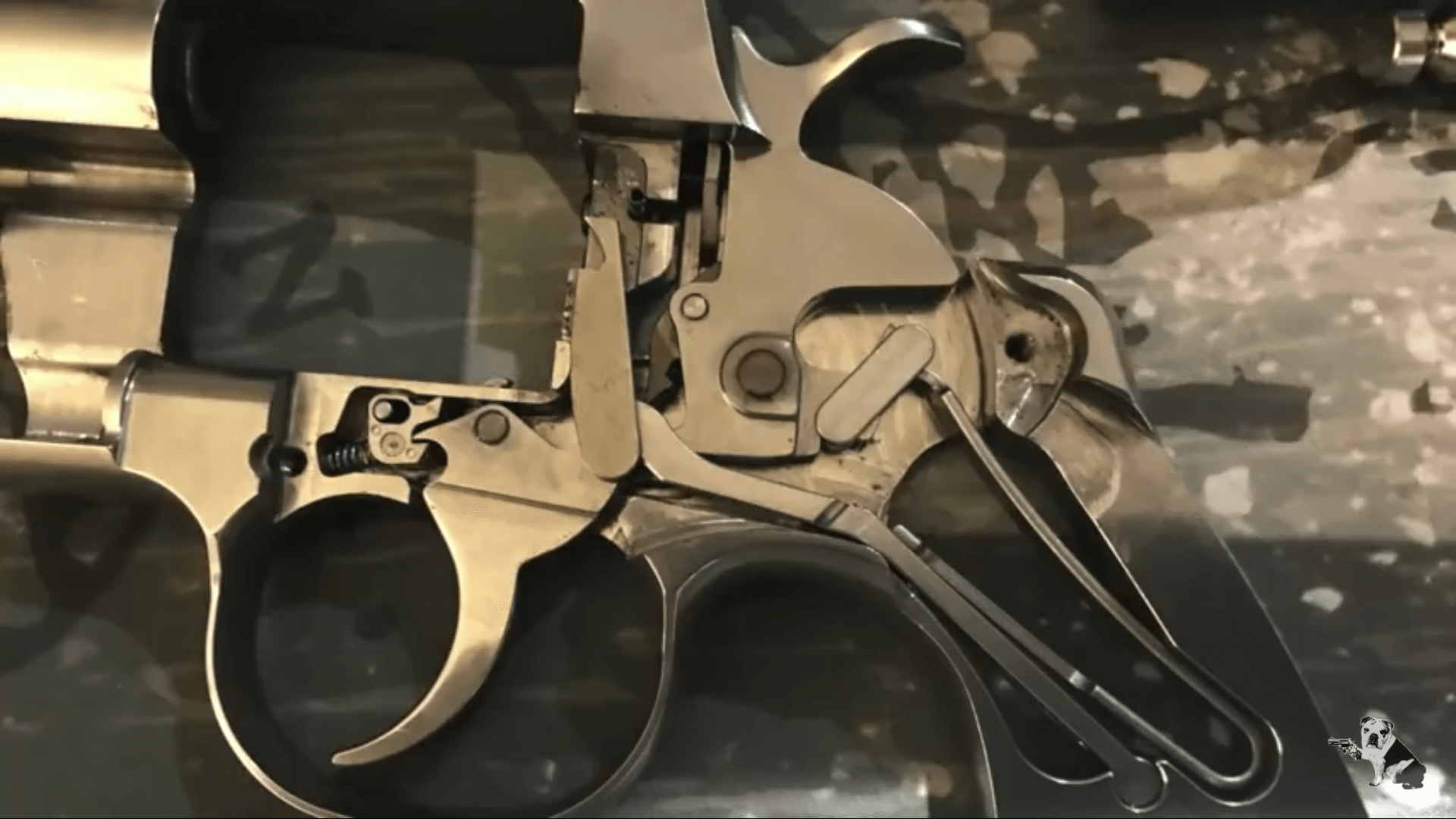
As I've mentioned before, the New Series double-actions share many design details with the Old Series. Some areas were entirely redesigned because a simple "beefing up" was not enough; other areas were "beefed up". All of it received new metallurgy that is far superior to the old. What this means is, Colt makes their parts to outrageously tight dimensions. The cylinder and its associated parts are all precision-machined, maintaining tolerances of .0001". The cylinder/ejector/ratchet assembly was redesigned as well. It is smoother, the parts are universal, and it's FAR more durable. Those are the parts on one side of the HAND (the hand is the part that rotates the cylinder and assists with lockup). On the other side of the hand, there are the internal parts: hammer, trigger, safety system, cylinder locking bolt, rebound lever, and mainspring. These are all made to the same standards as the cylinder. Despite the precision practices, "tolerance stacking" can occur. This can occur on either side of the hand, with it likely happening on both ends. It's unavoidable. Because a Colt is not like other revolvers, where the hand timing can be "fairly close" and still be fine, something needs to be fit. This is where, frankly, the "Pure Genius" rears its head. The hand is fit for each gun. By doing this, it compensates for all tolerance variations on both sides of the hand. They do this with computerized automated measuring, which in turn tells a CNC machine HOW to machine the hand, which the Colt worker placed in a jig while the system measured an assembled revolver (with the sideplate removed) for the last 20 or so seconds. Then the "machining center" machines this hand to the dimensions it needs to be for proper timing and lockup. It takes only like a minute. Fitting a hand, by hand, can easily be a half-hour + job. Colt's system works, and it works very well.
With that scholarly review, this is where the "conversation" comes in. There was a post on Instagram where a guy commented, "That little pony is why it's $1500". I explained to him why that was not the case. Of course, he argued about it. "You can get just as good of machining with many other brands". Well, no, you can't. They can't afford to do it. I will simply spell it out, warts and all. Smith & Wesson and Ruger consistently display signs of tooling (as in the cutting tools themselves, reamers, bits, etc) being overused. It will be past its prime, and they will still use it. How else can you explain a cylinder with six throats that has 2, 3, or 4 varying sizes? When cutting equipment wears, it cuts less. Reamers ream smaller holes than they once did. When a throat is cut, it's done on a vertical mill. All of the throats are reamed at the same time. So, if the cylinder is a six-shot, all six throats are reamed at once. Obviously, we want the throats to be within spec, but we also want them to be the same size. The key to achieving that is to check the cylinders regularly, and when you see evidence of just 1 reamer being out of spec due to wear, you replace all 6 reamers. If we have a cylinder with a vast cornucopia of throat sizes, obviously, they are replacing them one at a time. When a reamer simply can't cut anymore, then it's replaced. If it breaks, then it's replaced. Otherwise, they keep using it and using it.
So, what's the difference between replacing one or all six? Several hundred dollars. They are (likely) using carbide tooling. Carbide reamers cost a lot of money. I routinely buy them, and they can (easily enough) run well over $200 each. High Speed Steel is $80 - $100 each. The HSS doesn't last very long with today's steels. Now, here is where a BIG difference is present.
Heffron Precision© has tuned thousands of New Series Colt revolvers. We have also tuned a large number of Smith & Wessons as well. Sorry, I don't have a number. It's certainly well over 1000. We have dabbled in Ruger, but we have learned that to make a product we'll put our name on, the Ruger often requires a new barrel and a new cylinder. It is what it is. That being said, we have performed Blueprinted Accuracy Tuning© on approximately 4000 of the New Series Colts. Going through our logs, I have located a total number of revolvers with throat issues and/or dimensional forcing cone issues. Thirteen.
Smith & Wesson can only fantasize about such numbers. Our records indicate that when a S&W is inspected, there is an over 40% chance that it will need throat work and/or forcing cone work. Once everything is tuned up, they're great guns. I figured the PC guns would be better than that, but they are not. In fact, the Classic Series revolvers, which are made in the Performance Center, are among the worst measuring within their lineup.
Ruger can be even worse.
These are the facts. When you buy a New Series Colt double-action revolver, there is NO guarantee that it will be perfect. The old ones weren't perfect. You just didn't have social media present to tell you all about it. Not to mention "that guy" sharing his story of his cousin's great uncle's nephew's Godchild who bought a Python and the barrel fell off or whatever....
Keep in mind, "throat dimensions" are just 1 piece of a larger puzzle. I used this spec as an example, but there are many others to choose from. Colt clearly changes out their tooling at regular inspection intervals, and they do it in a complete manner. This is apparent in their barrels, forcing cones, cylinder throats, chambers, and cylinder to barrel alignment. Their double actions are the highest-tolerance domestically manufactured revolvers made. I have the proof.
And, even if you removed that "little pony" and replaced it with a donkey, it would still be $1500.
Everyone have a great week! -Mike
5/11/2026: NEW BILLING SYSTEM -
Because we're so busy we can't see straight, we are going to do more billing using this method. A SECURE EMAIL INVOICE. When it's time, we'll send you a secure email, with an invoice that's processed through the credit card company. It can be paid using a credit card or atm card. The invoice will outline the completed work and the total cost. So far, the invoices we have processed in this manner have gone smoothly. Just an FYI. Everyone have a great day! -Mike
5/8/2026: POSSIBLY A NEW AND LESS EXPENSIVE WAY TO SHIP HANDGUNS - DIY SERVICE IS ENTERING AT YOUR OWN RISK:
POSSIBLY A NEW AND LESS EXPENSIVE WAY TO SHIP HANDGUNS: This, if it goes through, could be fantastic. The United States Postal Service is considering a different policy regarding the shipping of handguns. You, the customer, can do it yourself. That's right. No FFL involvement. That is huge! That would uncomplicate the process and save quite a bit of money. If this sounds good to you (and I'm sure it does) contact your Congressional Representative and Senator.
The way it is right now, there is no ATF policy prohibiting a non-licensee from shipping a handgun to an FFL holder. The barrier is the shipping companies. They each (FedEx, UPS, USPS) have a policy where ONLY an FFL license holder, WITH a dedicated account with each respective company, can ship handguns. With such a policy, it might as well be an ATF policy! Let's hope this gains traction.
DIY SERVICE IS ENTERING AT YOUR OWN RISK: On a regular basis, I receive emails along these lines:
"I took my new model Python to a gunsmith to have the trigger made better. Now it doesn't work right."
There was a recent event where AFTER the gunsmith had wrecked parts, he told the customer, "I think I'm in over my head". Obviously.
The last gun we repaired after such an attempt needed a trigger, hammer, hand, and mainspring. The transfer bar spring/plunger was missing. We did a COMPONENT PART TRIGGER JOB© on the new parts. With return shipping and tax? The bill was a shade over $600. I have been receiving messages from DIY consumers or consumers who are the victims of gunsmiths who should have stuck to building AR-15s and replacing front sights on shotguns. The latest? Colt has had enough. Colt tells the customers, "We are not fixing such problems anymore. Contact Heffron Precision©. Maybe they can help you." While this may seem extreme, I really can't blame them. It's a liability thing. Someone who wasn't authorized got into that gun and changed things up. Then Colt is expected to fix it. It's difficult to tell exactly what may have been done to the gun sometimes.
Because I'm not an "assembler", like those at Colt, but rather a "tuner" that has tuned thousands of these, and also the guy who designed every angle, every cut, every stage, I know dimensionally what they should be new, what they should be when we're done. For a while, I was receiving revolvers from 3 different companies that have a comprehensive history with Colt revolvers, but the New Series was foreign to them. While topologically, they are extremely similar, dimensionally, they are extremely different. One after the other, these outfits tuned these New Colts. The finished guns suffered from poor timing, hammer push-off, light primer strikes, and, I kid you not, all of those problems for a 4-pound single-action trigger pull. I will just say it, they did not know what they were doing, period. When these customers would call the companies reporting their issues, the answer was consistently the same: "That's just the way these new Colts are. There's nothing you can do with them". I remember one customer who sent 3 New Pythons and 3 New Anacondas to one of these companies. When he got them back, they all were out of time, they all suffered from light primer strikes, and they all had trigger pulls that weren't that much better than stock (single-action). The double-action pull was nice because they ground the mainspring down to a nubbin. The guns wouldn't fire, though, so it really didn't matter anyway.
Several months ago on the Colt Forum, a guy posted how he tuned his trigger himself, and he had a 1.75 lbs single-action trigger and a 7 lbs double-action trigger, and he could reliably ignite magnum primers, and he encouraged others to do the same. Listen to me. You can't get parts. Parts for the New Series revolvers are at 2 places: Colt Firearms, and here at Heffron Precision©. Colt will not sell them or give them to you. Neither will I. I am bound by contract. I can't. We have to install the parts that we sell HERE. I have some more information for you. A 1.75 lbs SA pull is highly unsafe. It's due to sear engagement and the natural wearing in of parts. If that hammer doesn't have a push-off condition now, I guarantee that one day, it will. The second part reveals how the poster is likely filling our boots with something smelly. He claimed a DA trigger of 7 lbs that reliably ignites Magnum primers. THAT is impossible. A double-action trigger pull of 7 lbs, despite what angles are applied wherever, requires substantial lightening of the hammer's mainspring. 7 lbs will not reliably ignite Magnum primers! This isn't a half-baked opinion, WE HAVE RESEARCHED THE CAPABILITIES THOROUGHLY!! In fact, I would be surprised if Colt themselves has researched this as deeply as we have. The individual who made those claims is lying, or his trigger gauge is defective, or he doesn't know how to measure trigger pull despite saying multiple times, "This isn't my first rodeo". He also won't be there if you need parts. He can't get you parts (even though he claimed to work in the CNC machining field, and if he needed a hammer, he would just machine a new one exactly like the original with exactly the same steel and exactly the same heat treatment.....Hey, those were HIS words, not mine!)
Then we have the guy on YouTube who demonstrates how to tune your trigger. If your gun develops a problem because of what you've done, he won't be there either. I'm actually amazed that some people get pulled from YouTube because they show how to scrub a gun barrel, yet this guy is tearing a gun apart and modifying the trigger. Amazing.
We began tuning Colt revolvers in 1989 when the company was formed. I was doing it before that. I started working on revolvers at the age of 13 (1980) in my dad's factory service center, whether I wanted to or not! I'm glad I had that opportunity!
Here is the reality of doing a "trigger job" or "action job" on a New Series Python, Grizzly, Anaconda, or Kodiak. The internal design, while revised (updated), is basically the same as the old-series Colt actions. This means that EVERYTHING needs to be at the exact dimension, the exact angle, and the mechanical sequence must operate with the proper engagement timing of each part. They redesigned the locking bolt because the old one was impossibly delicate. They went from a hammer block to a transfer bar. The cylinder assembly was changed so it's stronger. All of the internal parts are made of new steel, and many are larger, but if it weren't for CNC precision, this action would be a hand-fit item all over again! If you tear it open with the intent of changing any parts, you are running just as high a risk of fitment and function issues as you were with the older Colts. Additionally, just because someone is competent with the old action doesn't mean they are competent with the new action. Every dimension between the two is different. Due to Colt's Bank Vault Lockup, the risks run high with the New Series Small Frames as well. I have seen a very high number of New Series Colts at gun shops (used) that I ask to handle, and when I do, all too often, it's clear that they do not function correctly. The gun is purchased, DIY "tuning" is attempted, the gun gets screwed up, and then it gets traded. Some unknowing customer will purchase this gun, then find out that things aren't right. I've seen that several times. That's when their "bargain" is no longer a bargain. It's sad, but true.
If your New Series Colt (or even Old Series) is victimized, we can get them on their feet again. We can tune them properly. Why do I say "properly"? Because the technique we use is the ONLY way we've found that improves the function, trigger pulls, and keeps the revolver in time. If you tuned your gun and it works OK, congratulations, you got lucky. I've found that the sear angle is hyper-critical. Just one degree this way, you will still be fighting the weight of the hammer spring. Just one degree that way and you'll have a hammer push-off condition. If the proper shape isn't applied, the timing will be incorrect, or the trigger will be lighter but have a ton of creep, or even both. It's a process we execute using in-house manufactured fixtures and a vertical milling machine. Of course, careful polishing follows.
Your gun is not my gun. We are backlogged with orders. It's not like I'm pleading for business. What I don't like are "gunsmiths" tackling jobs they have no business doing. They are not qualified. They can probably fix a shotgun bead better than I can. I also don't like it when someone wrecks a gun, then trades it off so it's someone else's problem. Not cool. This company is like The Revolver Hospital and The Revolver Fitness Center rolled into one. Due to demand, we are doing only Colts, but I've worked on many other brands in large quantities.
Those making videos or "rodeo-touting" within a forum about "how to", REMEMBER, they will not be around if things go south. Seriously, it ultimately doesn't make a huge amount of difference to me, but it just might to you when the damage is several hundred dollars.
Everybody, have a great weekend and stay safe! -Mike
5/5/2026: UPDATES - SHOP NOT OPEN THIS WEEK WILL REOPEN MONDAY, MAY 11th - EMAIL GLITCH - I HAVE HANDLED THE PIETTA "OLD SERIES" PYTHON COPY AND MY THOUGHTS:
The main update I have at this moment? As I type this on my trusty laptop, I just finished up with one appointment, and I'm patiently waiting for the next, which is 2 hours and 15 minutes from now. I periodically surf the web, and I look at stuff I don't need, but because it's a gun, well, I just might need that at some point. It is a good buy..... There are areas where you can invest your money, and it's a black hole. Guns, if you buy the right brands, they are not. When there is a loss, it's much less than other things, and they might even increase in value. Look at the Colts. If they discontinue a gun, the value explodes. There are some brands that have the opposite issue. When they discontinue a model, the value implodes. Polymer pistols are such an example.
WE ARE BEHIND, BUT WE ARE GAINING GROUND!!!: That is such a good feeling. We are gaining traction and closing gaps. I've switched things up a bit, which is helping out. I have another helper. He's unfortunately not a "forever" employee, but rather an up-and-coming gunsmith. He is sharp. Without me knowing about it, he took some new parts and "prepped" them for a New Series Python. After he was done, he asked, "Is this how they're supposed to be?" They were entirely fine. Now get this: He knew what parts to grab, what tools to use, and how to do what needed doing by watching the other guys for 2 days. Seriously? I haven't seen anything like this in at least 30 years. Maybe, someday, when I'm about... 95 years old, and I want to settle down, I can sell him the business. I could spend the next 15 - 20 years traveling or something. Hey, if you're going to dream, dream big! At any rate, I want to welcome Bill (we call him "Billiam") to the team!
SHOP NOT OPEN THIS WEEK WILL REOPEN MONDAY, MAY 11th: I am going to be in and out so much (mostly out) that we've decided not to operate this week, but rather get some essential maintenance done. It is time.
EMAIL GLITCH: I am so tired of this. EVERY email that's been sent to me prior to April 1st is gone. I hired an IT Professional to check this out because I thought it was a setting I mistakenly activated. Nope. According to him, this was likely a Malware issue. He explained that due to our encryption here, the contents are safe, but there's still a problem. We need those emails! It sounds like they are gone and will not be coming back. There were orders and all kinds of things in there. So, if you placed a COMPONENT PART TRIGGER JOB© order before April 1st, you might want to resend your information, because on this end, it's unfortunately gone. This is EXACTLY why I pay what I do for email encryption.
I HAVE HANDLED THE PIETTA OLD SERIES PYTHON CLONE: It's called the "Blacktooth". OK..... Regarding Colt 1873 SAA replica guns, at least those not requiring a second mortgage, Pietta is hands-down my brand of choice. Compared to the others (Uberti included), the steel is better (some of the Uberti steel is too soft....the screws are terrible), whereas others use their own dimensions. Pietta is a part-for-part clone of a Gen 2 1873 SAA. The only difference is the hand spring. Where the Colt uses a leaf spring that is peened into the hand, the Pietta uses a coil spring with a plunger that goes through the frame, which is actually better. Pietta used to use a leaf spring for this purpose, but in the Cowboy Action Shooting Sport, these guns are subjected to lots of abuse. Lots of "fanning", which is very hard on these guns. The leaf spring, which applied tension to the hand, would frequently break, which is what led to the coil spring/plunger system. I have swapped parts in both directions with Piettas and Colts. The Pietta SAA is nicely finished, attractive, and has that "balance" that many other clones fail to provide. The threads for the barrel and screws are even the same as the Gen 2 Colt! (or at least they used to be-I haven't looked at one for a couple of years). The Pietta screws are hardened. If you take them out, you don't rip up the slots (provided you use the correct screwdriver), where the Uberti, Taurus, and the old Armi San Marco guns.... those screws were going to get dinged up. It didn't matter. It's enough of an issue that there are companies in the aftermarket that offer hardened screws for Uberti guns. Where the clones, even the Super High End US Firearms clones, don't have replaceable firing pin bushings or replaceable hammer cams like a genuine Colt offers, but the Pietta has them. The parts are quality parts. However, making an old series Python clone is a far different animal than making an SAA clone. FAR different.
Now, don't get me wrong, I'm not picking on Pietta. My hat is off to them for even attempting such a thing. I can't help but think that the Blacktooth is the answer to a question that nobody was asking. If they had introduced a Colt New Service clone gun, I could have seen that. It's logical. Not to mention, it would be nice to buy a New Service-style revolver that was actually made from modern steel and heat-treated (these guns had very little in the way of heat treatment and are not very durable because of it). Some of the justifications for this gun given by Pietta (which is understandable) and Industry Professionals (who should know better than to say what they're saying) are practically laughable. Please allow me to share.
>IT OFFERS THE EXPERIENCE OF THE ORIGINAL PYTHON WITHOUT THE HIGH PRICE OF AN ORIGINAL: I have now handled one. No, it doesn't. They took a good shot at it, but it's not there. The one I examined had some timing issues. The single-action trigger was not what I would call "good", and that part could be due to the drop test issues that plague the industry, I don't know. The double-action trigger revealed a "feel" of things not being "finished," and the pull is light enough; I'm confident that Magnum primers are off the menu unless some work is done. My point is, with a single cock I could tell immediately that it was not a Python, old or new. They had spent days repeating it and dry-firing it, so there should have been some gains from break-in already. The "Bank Vault Lockup" that has been a feature of Colt double-actions since 1895 was not operating quite the way it should. If you have any hopes of that "deep as the sea" polished blue of the Old Python, you won't find that here either.
>THE PIETTA USES A "V" MAINSPRING JUST LIKE THE ORIGINAL, WHICH CONTRIBUTES TO THE AUTHENTIC EXPERIENCE: This mainspring thing.... It's really OUT there. The New Series Python uses a "V" mainspring, too. The area that used to be pointed (the bend in the spring) is now rounded, causing some to call it a "U" mainspring. If you ever see the letter "U" with non-parallel lines, please let me know. It's a "V" mainspring. Additionally, Pietta and gun writers are hanging their hats on whether or not the mainspring has a point? They have, for years, acted like the mainspring is the "secret sauce" of the Python, and it simply isn't true.
>IT'S A PART-FOR-PART COPY OF THE ORIGINAL PYTHON: Well, I don't think so. I don't know what's under the sideplate, but on the exterior, I saw differences. The ejector design/assembly for one. The Python action wasn't the only thing that could make grown gunsmiths cry. The cylinder assembly possessed an equally high capability of evoking pain and agony. The entire system was hand-fitted. No two were the same. Fitting an ejector or any other part within can drive one to madness, except me, of course, because I've done so many for so many decades, I fricking have dreams about it! Pietta can't afford to do that. Therefore, the ejector/ratchet/cylinder assembly does demonstrate visual differences, because there are differences! I don't care, just don't claim they're identical when they're not.
>FOR A FAR LOWER PRICE....: Sure. It's less money than the highly collectable Old Series Pythons. A pristine example of a Gen 2 Single Action Army is often worth more than a brand-new one. Here is a universal truth: the currently produced Colt Single Action Army is the best fit and finished of them all. No Gen of SAA has surpassed it. In fact, the others fall a bit short. Plus, the new SAA uses superior steel. I have a small collection of USFA (US Firearms) single-action revolvers, often touted as the best fit and finished single-action revolvers ever made by any company at any time in history. They truly are beautiful guns! BUT, the currently manufactured Colt Single Action Army surpasses them. Yup! You heard that here! Now more than ever, older does not necessarily translate into better. For not much more money, you can buy a brand new Python. I'll tell you what: buy a Blacktooth and a New Series Colt Python. In 5 years, trade them in, and you tell me how you did.
>"BUT THE NEW PYTHON ISN'T A REAL PYTHON": It's made by Colt, it says "Python" on the barrel, that means it's a real Python. Sure, it's a different Python; in fact, it's even superior. As shooters, we need to abandon the concept that "Lots of hand fitting" equals "superior quality". That, once upon a time, was the case. It is now the 21st Century. "Lots of hand fitting" actually translates into "This company has an engineering problem". Programmed machinery that's commanded by Computer Numerical Control (CNC) is the New Way. In fact, it's been in use for a very long time. How do you think Miroku made all of those beautiful firearms for Browning during the 70's? Now, get this: because "computer memory" was extremely limited, they used punch cards, sometimes recording tape, even a long roll of heavy paper that was like a practically endless punch card. It's the superior way. In fact, this machinery has reached a level of competency its inventors never envisioned. For example, let's say you have a workstation that machines frames. If it's one of the current higher-quality machines, the cutting bit/s will be inspected by the machine/computer. You can program it to do a check after every frame. You can program the tolerance. When the machining bit shows wear, the computer commands the machine to compensate for that wear. If a bit is chipped, it won't let you machine anything until the bit is changed out. This leads to tight tolerances and a high level of uniformity. This is a big deal! An example could be firearm engraving. There were some moderately engraved New Series Pythons on the market for a while that were laser-engraved, and there was a little more to it than that. The laser is guided by computer commands, which makes it CNC. A Python with that level of hand-engraving would easily exceed $10,000, but the laser-engraving added $600 - $700. The engraving is perfect. Hand engraving has some imperfections, but that is where the character of hand engraving reveals itself. Someone with that level of talent spent countless hours on your gun, if you can afford it. There will always be hand engraving, just like there will always be hand-built firearms, but can you afford it? What many don't realize is that the Python was never a money-maker. It was a statement. You may not realize it, but if you bought one of the old Pythons back when you could buy them new, you got a bargain. To build that gun today, the way they built it? MINIMUM $4000. More than likely higher. It was built the same way that Colt Officers Model target revolvers were built in 1930, back when skilled labor was extremely cheap. Actually, so cheap it was almost like stealing. This is what makes Heffron Precision© work: We take the New Series Colt Double-Action Revolvers and refine them to a substantial degree. Some work we do is by machine, some is by hand, but a skilled human touch is always involved. We "humanize" these fine revolvers in a GOOD way. Of course, we can repair or even tune your old Colt as well. I learned from the old Colts for decades, which helped to create our tuning services for the New Series Colts.
The Old Series Pythons were hand-fit because they HAD to be. The design could have been worked around with today's machines, but why? Colt did make some design changes to the New Series Pythons and every change was for a good reason. In terms of design topology, the New Python is VERY similar to the old, with changes in a few areas to enhance strength. That was important. Where on an Old Series, some of the parts were made literally by "freehand grinding", and others were made with machining equipment with extremely vague tolerances, the New Series Python maintains tolerances of .0001" - .001", depending on what the part is. The main mechanical design changes of the New Series are the cylinder locking bolt, which now functions the same way as a Ruger, Smith & Wesson, Dan Wesson, MKIII, and MKV Colt, and about any other double-action revolver you can think of. The Old Series Python action design (and with this I include 3 frame sizes, small frame-Pocket Revolver, Police Positive, Detective Special, Old Cobra, Agent, Diamondback, and the medium frame-Army Special, Officers Model, Official Police, original Trooper, Colt 3 5 7), and the large frame-New Service, New Service Target, Shooting Master) used a locking bolt system that was a carry-over from the 1873 SAA, which means it was a carry-over from Colt's earliest cap and ball revolvers. Believe me, that part is highly vulnerable to breakage! The internal parts, which are crucial due to Colt's locking mechanism, were never intended for something as ill-tempered as the 357 Magnum cartridge. Updates were needed.
With the updates came incredible tolerances courtesy of CNC machining. Redesigning certain elements, like the ejector/ratchet and again, the locking bolt, added strength. ALL parts that endure stress and punishment were enhanced with both girth and better steel. The New Python internal parts are still polished. The pivot points/fulcrums were optimized with the aid of AutoCAD. While the single-action trigger pull is admittedly over-the-top in weight (5.5 - 6.0 lbs due to drop test regulations-MOST are 5.25 - 5.75), many feel, myself included, that the double-action trigger pull is superior to the old Python. That's due to an optimized design. I want you to consider something. When you read about trigger pull specs for virtually any handgun, they'll give you (for the single-action pull) a range variance of 2, sometimes even 3 pounds. We're talking about the VARIANCE here. Now, before I say what I'm going to say next, please remember that the New Python's too-heavy single-action trigger pull is by design, to satisfy drop-test regulations. OK, with that being said, have you ever asked yourself why that pull on every Python is 5.25 - 5.75 lbs? Other revolvers have a single-action pull variance of up to 62%. The New Series Colt Python has a pull variance of 8.7%. While the stock pull weight is something we don't necessarily want, you have to admit, THAT is precision! Colt's cylinder tolerances on the new guns are incredible. When we used to work on them, we would routinely find Ruger, Smith & Wesson, and Dan Wesson revolvers with inconsistent cylinder throats or throats that were out of spec. After tuning several thousand New Series Colt revolvers, I can honestly tell you that the number of inconsistent throats and/or out of spec throats we have found is less than a dozen guns in total. That is astounding. Out of spec forcing cones are another frequent issue, but not on the Colt revolvers. Barrel quality? Again, Colt by a mile. Their barrels offer uniform dimensional accuracy that you simply don't see elsewhere. They even surpass the Smith & Wesson Performance Center guns.
With the New Series Python, you are paying for FAR more than a pretty face. You are buying crucial tolerances that cost big money to correct if they're not right the first time. I've read a thousand times, "Don't buy that Python! Get a 686. Way better gun!" Such statements are blind opinion or they're based on a sample size of 1. That 686 is likely to have inconsistent cylinder throats or out of spec cylinder throat, or an out of spec forcing cone, or all of the above! The same can be said of Ruger. I'll stop with the Dan Wesson speak because they no longer make revolvers and probably never will again. Don't get me wrong, I like Smith & Wesson revolvers and I see complete validity with their guns and Rugers, but (and I know this for a fact) the rate of warranty returns on Colt Products is LOWER than Ruger or Smith & Wesson, and if they were given a full workup, there would likely be problems they weren't even aware of. Problems that impact accuracy.
Then, of course, there's the steel. I don't know what Pietta is using. I will assume it's 4130, because it's what they use for their single-actions. 4130 is a good steel. But.......Colt really changed the rules metalurgically. Their stainless Pythons are made from 17-4PH. Their blue Pythons are made from 4350. Both of these steels offer approximately 70% greater tensile strength than 416 stainless and 4140 respectively, which were their previously used stainless and blued steels plus the steels of choice for Smith & Wesson and Ruger. The internal parts are made from 420HC with the stainless Python and some parts with the blue Python. Non-stainless parts are made from heat-treated 4140. These parts are hard and they are tough. Where the old Python is a testimonial to hand-finished revolvers, the New Python is a testimonial to the miraculous tolerances achieved with State of the Art Aerospace Grade AutoCAD design and CNC Machine technology.
After tuning and repairing several thousand Colt revolvers in my lifetime, I have learned that the Old Series Python, when used mostly in double-action mode with Magnum ammunition, will encounter a timing problem at around 2,000 rounds. If it was fired in dominantly single-action mode, it will encounter a timing problem at around 4,000 rounds. I have not seen or heard of a New Series Python experiencing a timing issue. My personal New Series Python, that I bought in February of 2020, has nearly 30,000 rounds of Magnum ammunition through it. Other than a trigger and action tune, I've never had the sideplate off. I haven't HAD to take it off. The timing is perfect. Last, but not least, there is accuracy or grouping capability. We have records a mile high regarding Old Series Python accuracy. Taken as a whole, there is no question, they were the tightest-grouping 357 Magnum revolvers made. Over the last six years, we have tested a great many New Series Pythons. Comparing group size averages, Old Series to New Series, the New Series Pythons offer superior out of the box accuracy. Then, of course, we accuracy tune many of these. When we do what we do, these revolvers HAVE TO shoot 2.50" groups at 75 yds with the 2.5" and 3.00" barrels, 2.5" groups at 100 yds with the 4.25" barrel, 2.25" groups at 100 yds with the 5" barrel, 2.00" groups at 100 yds with the 6" barrel, and 1.75" groups at 100 yds with the 8" barrel. Hand rifle anyone?
So, we have at minimum 30,000 round durability (it will do much more, trust me), and the potential for action tuning that will still ignite Magnum primers with a single-action trigger of 2.00 - 2.25 lbs and a double-action trigger of 8.00 -8.25 lbs, the action tuned to a butter-like state while maintaining anvil-like durability, and superior out of the box accuracy compared to the Old Series Python with tuned grouping potential of 1.75" at 100 yards....
The Python and the Blacktooth are actually pretty close in price. This isn't like a Pietta single-action 1873 clone being $600, and a genuine Colt 1873 being $2500. In the single-action rhelm, that's a price difference of 317%. The Blacktooth is $1100 and the Python is $1600. That's a price difference of 45%.
Can the Blacktooth offer the performance you truly want? Will people who see it on the range be impressed by it? Do keep in mind, those who had a 1-gun problem or read about whatever on a forum or their cousin's-uncle's-wife's-Godchild had problems...whatever. They don't count.
$1100 is a chunk of change. I want something that IS something and can easily be tuned beyond conventional potential. If I'm in the mood for another Python, (which does happen), I will buy another PYTHON.
Everyone have a safe week. Have a good week. Until next time. -Mike
3/31/2026: IF WE HAVEN'T REPLIED TO YOUR EMAIL YET:
It's certainly not because I don't care, it's because I'm still trying to figure out which end is up! Such is life; it's taking longer to catch up than I anticipated. Tammy and I are doing everything we can with shipping, we're doing all that we can for the emails, and Lawrence, Matt, and I are doing all that we can in the shop. With all of the paperwork required in this business, it's amazing that we find the time to do what actually keeps the lights on!
IF WE HAVE NOT REPLIED TO YOUR EMAIL YET REGARDING AN ORDER, EXISTING OR ONE YOU WANT TO PLACE, we are working our way there. For example, over the weekend, neither Tammy nor I did anything with the emails. That is unusual, but we let it be until Monday morning. Now, keep in mind we have A LOT of past emails to work through... We were greeted with 682 NEW emails. After we got the "JUNK" sorted out, we were left with 411. So many of the emails are of a technical nature that my wife cannot help with those. Phone time? Right now? There's just no way. I miss it. I really enjoy talking with my customers.
We will get to your email. I have someone coming in to help who will be assisting in that area with our other computer. The stuff they cannot answer, they will have to leave for me. Success has its quirks. Did I tell you that while I was at an event a while back, someone actually asked me for my autograph? (The only problem is they thought I was George Thorogood.)
CERTAIN SERVICES ON THE SERVICE PAGE TEMPORARILY DELETED: This is only until we get the new service descriptions up. There have been some changes. The Signature Series© has undergone the most significant improvements ever, so much so that we were able to tighten the accuracy standard. The actions are the best they've ever been. With our Component Part Trigger Job©, I feel it's not described well enough. I want to include photos of the parts we need. I want to include a better description of what we do. Until these are up, the others are coming down. (NOTE: This only impacts the New Series Colt double-action revolvers)
Everyone have a safe and fantastic week! -Mike
2/12/2026-THE SHOP - GETTING TO EMAILS ONE STEP AT A TIME - MORE GUNS FOR SALE:
>VERY BUSY IN THE SHOP: After what I THOUGHT was going to be a relatively short and easy departure just here and there due to medical issues, I witnessed it becoming a lengthy, complex, and departed departure. For several weeks, even months, I was not here. I am eternally happy with the Mayo Clinic Hospitals in Rochester, Minnesota for their care team. I am eternally grateful to God for getting me through it and making the condition I'm in now possible. While I can't say that I'm 100% yet, I am gaining and I am almost back to my 12 - 14 hour days (right now it's 8 - 12 depending on the day). They have officially labeled me as "FIXED" and I am ready for it!
Of course, this has done wonders for our backlog (NOT!). Our Master Gunsmith Lawrence, due to his wife's worsening health plus his own health issues has officially resigned from Heffron Precision©. He was overwhelmed with guilt about leaving right now. I told him the truth. He doesn't have a choice! He is in a crisis and he is retirement age. It's time for him to retire so he can take care of his business. He will be missed. He was here a long time. He was highly skilled and he was a real character! I know that I will miss him and I hope that he stops by the shop and my home when he has time. A fantastic guy. Our machinist Matt is still here. He is running something constantly. He does an extremely good job. He was born with a gift, and I'm glad that he's putting it to work for us.
So, what does this mean? It means that ALL parts prep and ALL repairs will be handled by me, and me alone. I personally will be doing every revolver that comes through here from start to finish. I will not be rushed. I don't wish to sound stubborn, but I have my own way of doing things. The end result speaks for itself I believe. Keep in mind, as I announced a while back, ALL scheduled Precision Series© tunes and Master Series© tunes will be replaced with the service that replaced them both, the Component Part Master Tune©. This fully offers Master Series© performance and all you send in are some internal parts. It saves you time and it saves you money and the end result is the same. It's a WIN-WIN!
>GETTING TO EMAILS ONE STEP AT A TIME: I have been working through the emails that accumulated during my lengthy departure. Tammy has been helping with that as well. The problem is phone time. I simply don't have the time to work the phone. Please email us. I realize some of you have unanswered emails, and we're getting to them. Thank you for your patience and understanding.
>MORE GUNS FOR SALE: I have dug out some of our trade guns. There are some really nice guns for really good prices! Check it out. Classic Colts and more. Check them out and please email us with any questions.
Everyone have a fantastic and safe weekend. -Mike
1/14/2026: PAST BLOG FROM 2025 ARCHIVED -- COMPONENT PART TUNES THAT WERE MISSED -- CURRENT STATUS:
PAST BLOG INFO FROM 2025 ARCHIVED: We have to do that or the page gets bogged down so bad we can't work with it. ALL past blogs can be found at the bottom of this page in PDF format.
COMPONENT PART TUNES THAT WERE MISSED: Within a couple of days of my return, I noticed a bunch of component part tunes boxed up. In my absence, they were completed, but NOT shipped! There will be some going out today, tomorrow, and Friday. ALL of the shipping labels have to be made yet. Due to the volume, I will be using FedEx. Please accept my sincere apologies. This is the penalty for being a micro-manager.
CURRENT STATUS: The current status is, I'M ALL BETTER!!!! After a string of....crap, I can honestly say that I feel the best I have felt in a few years. This is fixed, that is fixed, I am doing good. I am working my butt off in the shop to get things going. THANK YOU ALL FOR BEING SO PATIENT!! Additionally, despite efforts to keep track, I know there have been calls and emails that have "slipped by". I (and Tammy when she's here) will be working on the emails the best we can. With Tammy being out most of this week (she has a family health issue of her own she is dealing with now) and 2 guys on the "sick list", I am going to be alone all of this week. IF YOU WANT TO GET A MESSAGE TO ME PLEASE SEND AN EMAIL. OUR PHONE SERVICE DOES NOT TAKE MESSAGES. I don't know how available I will be for phone time. I am getting stuff done and getting stuff shipped.
I am very grateful for the health gains maid. Like I said, I feel the best I have felt in years. I think that I actually feel like someone who's 58 years old!!
Everyone have a safe and fantastic week. -Mike